
Most adults should regularly get at least seven hours of sleep. MedlinePlus describes seven to nine hours as a useful general range for adults. Eight hours falls within that range, but it is not an exact requirement for every person.
The number of hours matters, but so do sleep quality, schedule consistency, health, and how alert you feel during the day. This guide explains the general recommendations for adult sleep, why individual needs vary, and how to look beyond the clock.
Quick Takeaways
- Most adults should regularly get at least seven hours of sleep.
- Seven to nine hours is a useful general range for many adults.
- Eight hours is a reference point, not a universal requirement.
- Time in bed is not always the same as time actually asleep.
- Persistent sleep problems or daytime sleepiness deserve professional attention.
How Many Hours of Sleep Do Most Adults Need?
The general recommendation for adults
The Centers for Disease Control and Prevention states that adults should get at least seven hours of sleep each day. MedlinePlus offers a broader public-facing range of seven to nine hours for adults ages 18 and older.
These recommendations are starting points for the general population, not individualized prescriptions. Some adults may regularly need more sleep than others. The number should be considered alongside sleep quality, health, schedule consistency, and daytime alertness.
Why eight hours is a reference—not a rule
Eight hours is easy to remember and sits within the commonly recommended seven-to-nine-hour range. It can be a useful target, but it should not become a pass-or-fail test.
Someone who regularly sleeps a little more than seven hours may feel alert and function well, while another person may need closer to nine. A persistent need for much more or much less sleep deserves context rather than an automatic conclusion.
General Sleep Guidance for Adults
| Guidance | General recommendation | Important context |
|---|---|---|
| Consensus minimum for adults | At least 7 hours regularly | Some adults may need more |
| Common public-facing range | About 7–9 hours | Individual health and circumstances vary |
| Older adults | About 7–9 hours | Sleep may become lighter or more interrupted |
Different health organizations may present adult sleep guidance in slightly different ways. The CDC uses age-specific recommendations, while MedlinePlus and the National Institute on Aging describe seven to nine hours as a useful general range for adults, including older adults.
Keep in mind: General sleep recommendations provide a useful starting point. They cannot determine one person’s exact needs.
Why Sleep Needs Can Vary
Age and life stage
Sleep patterns often change with age, but older adults do not simply stop needing as much sleep.
The National Institute on Aging says older adults need about the same amount of sleep as other adults—approximately seven to nine hours each night. They may go to bed earlier, wake earlier, sleep more lightly, or experience more interruptions.
Work schedules, caregiving, travel, and other routine changes can also affect when and how consistently people sleep.
Health, stress, and daily demands
Age, lifestyle, health, and usual sleep patterns can influence how much sleep a person needs and how rested they feel. Illness, physical recovery, stress, or a major schedule change may temporarily affect sleep.
Feeling tired does not automatically mean that duration is the only issue. Sleep quality, timing, health conditions, medications, and other circumstances may also play a role.
Recent sleep loss
When sleep is repeatedly cut short, the missed time can accumulate. The National Heart, Lung, and Blood Institute calls this accumulated loss sleep debt.
Sleeping longer after an unusually short night may feel helpful. However, relying on occasional naps or weekend catch-up sleep is not the same as getting adequate nighttime sleep consistently. NHLBI notes that naps can temporarily improve alertness but do not provide all the benefits of nighttime sleep.
Sleep Duration Is Only Part of the Picture
Sleep deficiency is broader than simply sleeping too few hours. It can also involve sleeping at the wrong time, getting poor-quality sleep, or having a sleep disorder that interferes with rest.
Time in bed is not always time asleep
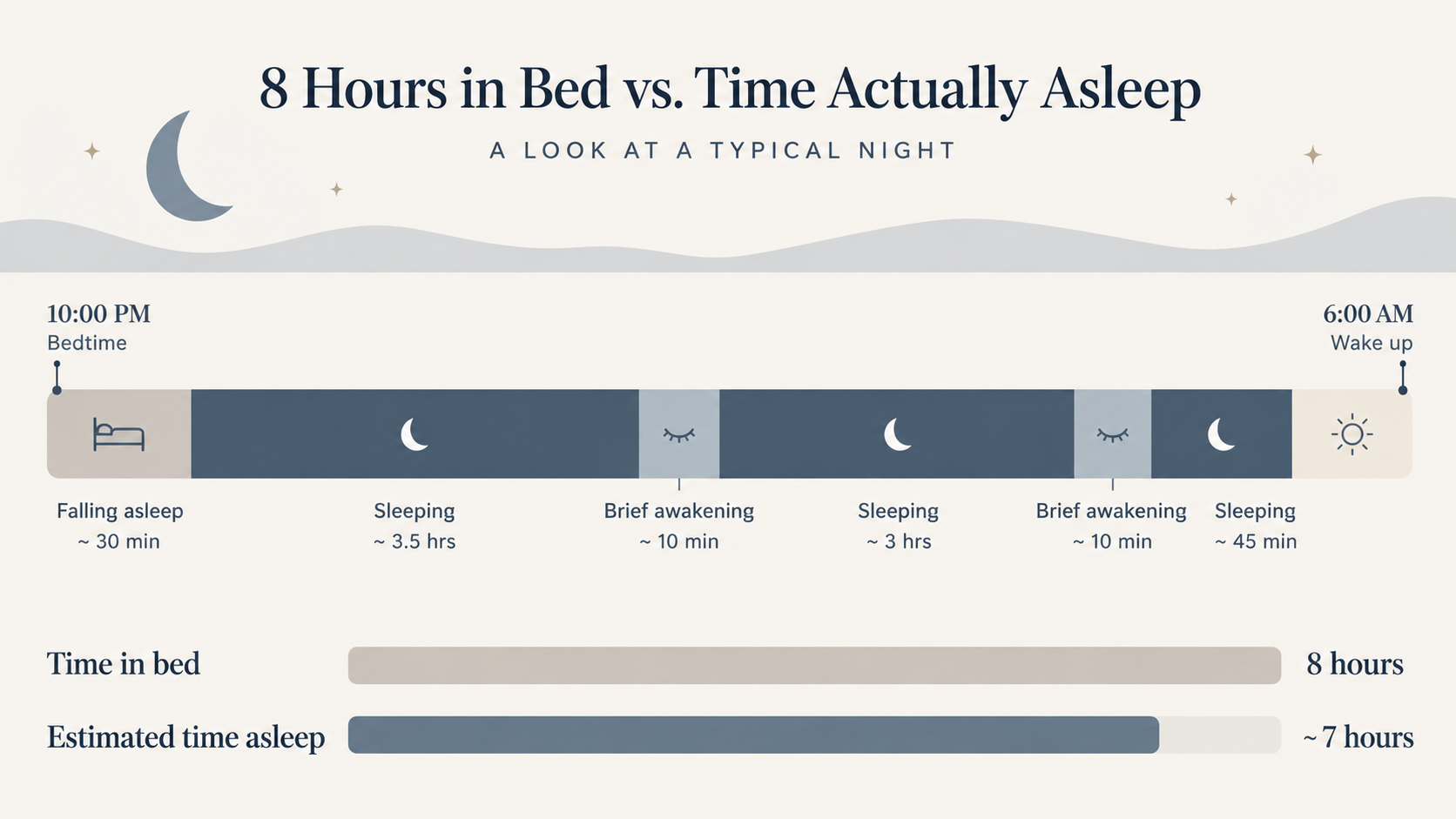
Suppose you go to bed at 10:30 p.m. and get up at 6:30 a.m. That gives you eight hours in bed, but it does not necessarily mean you slept for eight hours.
You may have needed time to fall asleep, awakened during the night, or woken before your alarm. Looking only at bedtime and wake time can therefore overestimate your total sleep.
Sleep quality matters too
Healthy sleep involves both sufficient duration and good quality. Frequent awakenings or regularly feeling unrefreshed may mean that the number of hours is not telling the whole story. The CDC identifies sleep duration and quality as important parts of healthy sleep.
Feeling tired after eight hours does not identify a specific problem by itself. Persistent tiredness may involve sleep quality, timing, health conditions, medications, or other factors.
Consistency helps reveal the pattern
One short night does not necessarily describe your usual sleep. It is more useful to look across the week:
- Are your bedtime and wake time relatively stable?
- Do you sleep much longer on weekends than on weekdays?
- Has your schedule changed recently?
- Are you regularly shortening sleep to meet other demands?
Consistency does not require a perfect routine. The goal is to notice whether your schedule usually gives you enough opportunity to sleep.
How to Tell Whether You May Be Getting Enough Sleep
Look at patterns, not one morning
A difficult morning may follow stress, illness, a late night, or an interruption outside your control. Look instead at your usual pattern over several days.
You do not need a wearable device to begin. A simple written note of your bedtime, wake time, estimated time to fall asleep, nighttime awakenings, and daytime alertness may reveal useful patterns.
Consumer sleep trackers may provide estimates, but they should not be treated as diagnostic tools.
READ MORE:
Caffeine and Sleep: Timing, Sensitivity and Better Daily Choices
Pay attention to daytime functioning
How you function during the day adds useful context. Persistent sleepiness may interfere with work, driving, concentration, and other daily activities.
Consider seeking guidance when you frequently:
- struggle to remain alert during normal activities;
- feel sleepy while driving or performing safety-sensitive tasks;
- have ongoing difficulty concentrating;
- need substantially more sleep on days off after repeatedly short weekday sleep;
- remain unrefreshed despite giving yourself enough time to sleep.
These experiences do not prove that you have a sleep disorder.
A Simple Weekly Sleep Check-In
- I noted my usual bedtime and wake time.
- I considered how long it usually takes me to fall asleep.
- I noticed whether I wake frequently during the night.
- I paid attention to how alert I feel during the day.
- I compared weekdays with weekends.
- I noted major recent changes in my health or routine.
This check-in is not a diagnostic test. It is simply a way to notice patterns you may want to discuss with a qualified healthcare professional.
When to Talk With a Healthcare Professional
Consider seeking individualized guidance when you experience:
- persistent difficulty falling or staying asleep;
- ongoing daytime sleepiness;
- sleepiness that affects driving, work, or personal safety;
- a major and lasting change in your usual sleep pattern;
- concerns related to a health condition or medication.
If someone notices that you snore, gasp, or repeatedly stop and restart breathing during sleep, consider discussing it with a healthcare professional. These signs can occur with sleep apnea, but they do not confirm a diagnosis on their own.
When to get help: Do not rely on an online checklist or consumer sleep tracker to diagnose insomnia, sleep apnea, or another sleep disorder.
Medical note: This article provides general educational information and is not a substitute for individualized medical advice. Speak with a qualified healthcare professional if sleep problems persist, affect your daily functioning, or create safety concerns.
Frequently Asked Questions
Is seven hours of sleep enough for adults?
Seven hours is the minimum included in major guidance for adults, but it may not be enough for every person. Many adults need somewhere within a seven-to-nine-hour range. Consider the pattern over time rather than treating seven hours as a universal target.
Do adults need less sleep as they get older?
Not necessarily. Older adults generally need about seven to nine hours, similar to other adults. Their sleep may become lighter or more interrupted, which can make continuous sleep harder to obtain.
Can you catch up on sleep over the weekend?
Extra sleep may feel helpful after a short night, but it is not a complete substitute for regularly adequate sleep. Repeated sleep loss can accumulate as sleep debt.
Why am I still tired after eight hours of sleep?
Eight hours in bed may not equal eight hours asleep. Frequent awakenings, an irregular schedule, health conditions, medications, or other factors may contribute. Persistent tiredness deserves individualized attention rather than self-diagnosis.
The Bottom Line
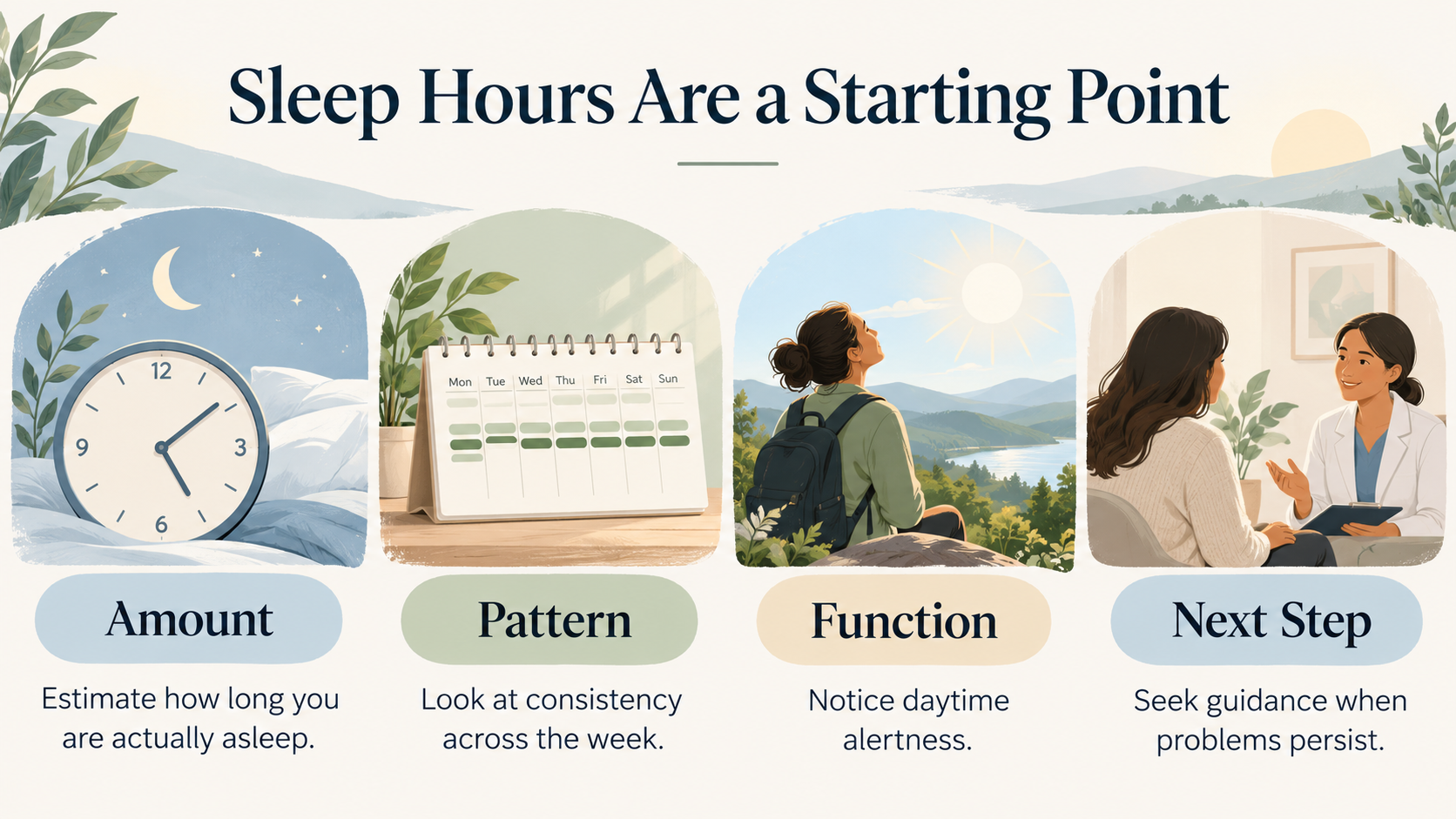
General adult sleep guidance is a useful starting point, not a precise formula for every person. Pay attention to how much time you are actually asleep, your usual pattern across the week, and how alert you feel during the day.
Persistent sleep problems, major changes in your usual pattern, or sleepiness that affects safety deserve professional guidance.
Start with the general recommendations, then observe your sleep pattern across the week without treating one difficult night as the whole story.
Sources
- Centers for Disease Control and Prevention — About Sleep
https://www.cdc.gov/sleep/about/index.html - Centers for Disease Control and Prevention — FastStats: Sleep in Adults
https://www.cdc.gov/sleep/data-research/facts-stats/adults-sleep-facts-and-stats.html - MedlinePlus — Healthy Sleep
https://medlineplus.gov/healthysleep.html - MedlinePlus — Sleep Disorders
https://medlineplus.gov/sleepdisorders.html - National Institute on Aging — Sleep and Older Adults
https://www.nia.nih.gov/health/sleep/sleep-and-older-adults - National Heart, Lung, and Blood Institute — What Are Sleep Deprivation and Deficiency?
https://www.nhlbi.nih.gov/health/sleep-deprivation - National Heart, Lung, and Blood Institute — How Much Sleep Is Enough?
https://www.nhlbi.nih.gov/health/sleep-deprivation/how-much-sleep