
Healthy sleep habits are not about following a perfect bedtime routine. They are the everyday patterns and conditions that can be part of a more consistent sleep routine—from the light you get during the day to the way you prepare your bedroom at night.
There is no single routine that fits every job, household, health situation, or season of life. A practical approach is to identify one recurring source of friction and begin with a change you can realistically repeat.
This guide explains the main parts of a healthy sleep routine, why they may matter, and how to adapt them to everyday life.
Quick Takeaways
- Reasonable consistency can be useful without requiring a perfect schedule.
- Daytime light, movement, caffeine, and alcohol can all be relevant to sleep.
- A quieter evening transition may make it easier to prepare for bed.
- Your bedroom should be as comfortable, dark, and quiet as your circumstances allow.
- Persistent difficulties, breathing concerns, or significant daytime sleepiness deserve professional guidance.
What Are Healthy Sleep Habits?
Healthy sleep habits are commonly recommended behaviors and environmental choices that may support more consistent, good-quality sleep.
Sleep health involves more than the number of hours spent in bed. Duration, timing, regularity, quality, and the possible presence of a sleep disorder can all be relevant. Most adults need at least seven hours of sleep, although age-based guidance and individual needs vary.
What “Sleep Hygiene” Means
You may also see healthy sleep habits described as sleep hygiene. The term generally refers to behaviors and conditions related to sleep, including scheduling, light exposure, caffeine use, evening activities, and the bedroom environment.
Sleep hygiene is a common term, but it does not refer to one completely standardized protocol. A 2024 bibliographic review found no consensus on its definition or core components, so it is more useful here as a practical category than as a rigid checklist.
Healthy Habits Are Only One Part of Sleep Health
General habits can support everyday well-being, but they do not diagnose or treat insomnia, sleep apnea, or another medical condition.
Keep in mind: General sleep guidance can be useful, but schedules, health circumstances, living environments, and individual needs vary.
The Main Parts of a Sleep-Supportive Routine
A practical routine can be organized around four broad areas: consistent timing, daytime choices, a gradual evening transition, and a comfortable sleep environment.
You do not need to optimize every area. Look for the factor that creates the most friction and is realistic for you to change.
Sleep Habit, Why It May Matter, and a Realistic First Step
| Habit or area | Why it may matter | Realistic first step |
|---|---|---|
| Consistent timing | Supports a more predictable daily pattern. | Choose sleep and wake times you can follow on most days. |
| Daytime light | Provides timing cues for the sleep-wake cycle. | Spend time outdoors during the day when possible. |
| Caffeine awareness | Caffeine may affect sleep for several hours. | Notice when you have your last caffeinated drink. |
| Daytime movement | Regular activity may support sleep quality. | Choose movement that fits your health and schedule. |
| Evening transition | Creates separation between daytime demands and bedtime. | Repeat one calming activity before bed. |
| Bedroom environment | Light, noise, and discomfort can make rest more difficult. | Reduce one avoidable distraction. |
These areas align with general guidance from the CDC, NHLBI, and MedlinePlus.
Build Consistency Without Expecting Perfection
Keep Your Timing Reasonably Consistent
Going to bed and waking up at approximately the same times can help create a more regular sleep-wake pattern. The CDC, NHLBI, and MedlinePlus all include consistent sleep and wake times among their general recommendations.
That does not mean every day must look identical. Work, children, travel, social plans, and unexpected responsibilities can change your schedule.
Keeping both bedtime and wake time reasonably consistent can support regularity. In practice, some people find wake time easier to plan around. It should still allow enough opportunity for sleep.
After an unusual night, return to your usual pattern when practical rather than treating the entire routine as lost.
Use Repeatable Evening Cues
A bedtime routine does not need to be long. One or two repeatable cues may help create a clearer transition into the evening.
You might:
- prepare what you need for the next morning;
- dim some of the lights;
- take a shower or bath;
- read something calm;
- write down unfinished tasks;
- choose a quiet activity that feels familiar.
The goal is not to create an elaborate ritual. It is to find a transition that fits your life.
Pay Attention to Daytime Habits
Use Daytime Light as a Timing Cue
Light helps provide timing signals for the sleep-wake cycle. Spending time outside during the day may strengthen daytime cues, while reducing bright artificial light at night can be part of preparing for sleep.
The effects of light depend on factors such as timing, intensity, duration, and individual circumstances. A general wellness article should not turn those factors into a rigid light schedule.
Include Regular Daytime Movement
Regular physical activity may support sleep quality, although results vary by population, type of activity, and study design. A 2024 meta-analysis found that exercise interventions improved measures of sleep quality in adults.
Choose a form of movement that fits your health, ability, interests, and schedule.

Notice Your Caffeine Timing
Caffeine can be found in coffee, tea, energy drinks, many sodas, chocolate, and some medications or supplements.
Research has linked caffeine consumption with longer sleep-onset time, reduced total sleep time, and lower sleep efficiency. Its effects depend on dose, timing, usual intake, metabolism, and individual sensitivity.
There is no universal cutoff time that works for everyone. A useful first step is to notice when you have your final source of caffeine and whether changing that timing affects your pattern.
Consider Alcohol and Large Evening Meals
Alcohol may make some people feel sleepy initially, but it can also contribute to fragmented sleep and earlier waking. It should not be treated as a sleep aid.
Large or heavy meals close to bedtime may also cause discomfort for some people. Public-health guidance generally recommends avoiding large meals and alcohol near bedtime while allowing for individual needs.
READ MORE:
10 Evening Habits That May Make It Easier to Wind Down
How to Create a Sleep-Friendly Bedroom Without Spending Much
Make the Bedroom More Sleep-Friendly
Focus on Light, Noise, and Comfort
A sleep-friendly bedroom is as dark, quiet, relaxing, and comfortably cool as your circumstances allow. These environmental factors appear consistently in guidance from the CDC, NHLBI, and MedlinePlus.
You may not control traffic, neighbors, household schedules, room temperature, or whether you share the space. Focus on changes that are available to you rather than trying to create an ideal bedroom.
Possible starting points include:
- reducing one source of light;
- silencing avoidable notifications;
- moving work materials out of direct view;
- addressing a manageable source of noise;
- adjusting bedding for comfort;
- preparing the room before you feel tired.
You may be able to make the space more comfortable without buying anything.

Create a Gradual Wind-Down
Reduce Stimulation Gradually
It can be difficult to move directly from work, problem-solving, or stimulating entertainment into sleep. A simple wind-down creates some separation between the demands of the day and the time you intend to rest.
You might lower the lights, wash up, prepare for the next morning, write down tomorrow’s tasks, read, listen to quiet music, or practice slow breathing.
These activities can support an evening transition, but they should not be presented as treatments for anxiety, insomnia, or another health condition.
Use Screens More Intentionally
Public-health guidance commonly recommends reducing electronic-device use and bright artificial light before bed. However, screen use is not necessarily an all-or-nothing issue. Brightness, content, notifications, time spent scrolling, and whether a device delays bedtime may all matter.
Instead of aiming for an immediate ban, consider one manageable boundary:
- lower the brightness;
- turn off nonessential notifications;
- avoid work messages during part of your wind-down;
- choose calmer content;
- place the phone out of reach when you are ready to sleep.
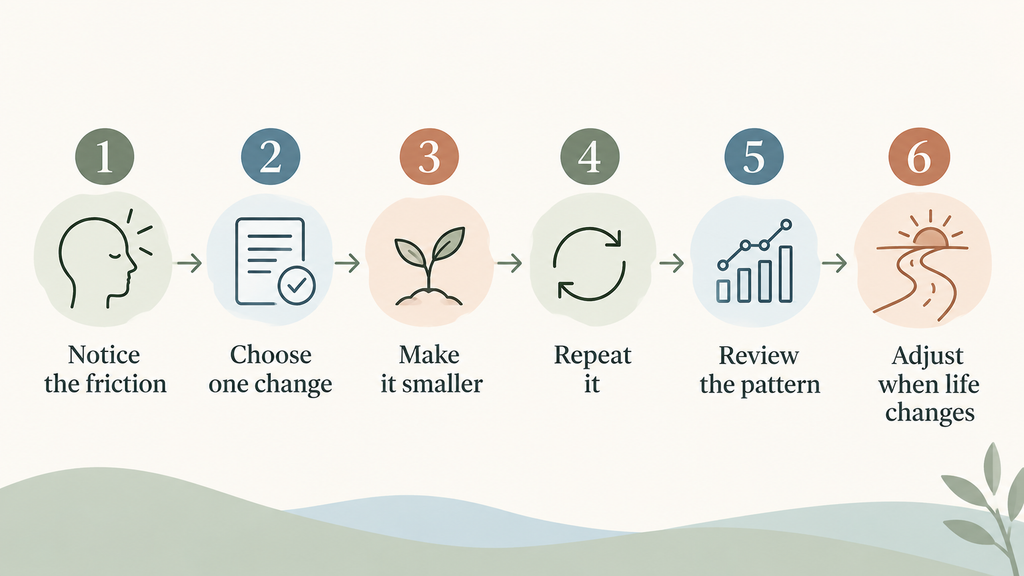
How to Start Without Changing Everything
Start here: Choose one manageable area to work on first. You do not need to rebuild your entire routine at once.
- Notice the main source of friction. Is it irregular timing, late caffeine, a noisy room, unfinished work, or another recurring issue?
- Choose one manageable change. Pick something you can control.
- Make the change smaller if needed. A modest version still counts.
- Try it consistently. Give yourself a chance to notice a pattern.
- Review the general pattern. Avoid judging each night on its own.
- Adjust when life changes. A useful routine should be flexible.
For example, you might begin your evening transition slightly earlier, move your final caffeinated drink to an earlier part of the day, or reduce one recurring bedroom interruption.
Common Sleep Routine Mistakes
Trying to change everything at once. Too many simultaneous changes can make a routine difficult to maintain.
Treating general guidance as strict rules. Recommendations are starting points, not measures of personal success.
Focusing only on bedtime. Light, movement, caffeine, alcohol, and scheduling during the day may also be relevant.
Expecting one habit to solve every problem. Sleep can be affected by health conditions, medications, stress, schedules, and environmental factors.
Buying products before understanding the problem. Start by identifying the source of friction rather than assuming you need a device, app, supplement, or accessory.
When Healthy Sleep Habits May Not Be Enough
When to get help: Consider speaking with a qualified healthcare professional when sleep difficulties persist, interfere with daily life, or create safety concerns.
Difficulty falling asleep, frequent waking, or unrefreshing sleep can have many possible explanations. When sleep problems affect everyday activities, a healthcare professional can help determine whether further evaluation is appropriate.
A brief sleep diary can help you record sleep timing, awakenings, naps, caffeine or alcohol use, medications, and daytime sleepiness before an appointment.
Loud snoring, gasping, observed breathing pauses, or excessive daytime sleepiness can be reasons to ask a healthcare professional about sleep apnea. These signs do not confirm a diagnosis on their own.
Significant sleepiness can also interfere with work, school, driving, and other daily activities. Difficulty staying awake during a safety-sensitive task should be treated as a safety concern.
Healthy habits are not a substitute for individualized treatment. For adults with chronic insomnia, professional guidelines recommend cognitive behavioral therapy for insomnia, or CBT-I, as a first-line treatment. Sleep-hygiene education may be one part of CBT-I, but it is not the complete treatment.
A Realistic Sleep Routine Checklist
- I have reasonably consistent sleep and wake times.
- I get some daylight during the day when possible.
- I pay attention to caffeine timing.
- I include movement that fits my health and schedule.
- I have a simple way to wind down.
- My sleep space is as comfortable as I can make it.
- I reduce avoidable interruptions before bed.
- I know when ongoing sleep concerns deserve professional guidance.
This checklist is not a score or a diagnostic tool. Use it to identify one possible starting point.
Frequently Asked Questions
How Long Does It Take to Build Better Sleep Habits?
There is no universal timeline. How quickly a routine feels familiar depends on your schedule, circumstances, and the size of the change.
Choose one habit you can repeat and review the general pattern rather than expecting every night to improve in a straight line.
Is a Consistent Wake Time More Important Than a Consistent Bedtime?
Both bedtime and wake time contribute to a regular schedule. A wake time may be easier for some people to plan around, but it should not reduce the opportunity to get enough sleep.
Aim for reasonable consistency rather than forcing an identical schedule when circumstances temporarily change.
Do I Need to Stop Using Screens Completely Before Bed?
Not necessarily. Reducing bright light and stimulating device use may help some people prepare for sleep, but a realistic change may involve brightness, notifications, content, or how long the device delays bedtime.
Choose a boundary that fits your needs.
What Should I Change First to Sleep Better?
Begin with the biggest recurring source of friction that you can reasonably control.
That might be an inconsistent schedule, late caffeine, a bright room, work continuing into bedtime, or frequent notifications. Make the first change small enough to repeat.
Build a Routine That Fits Your Life
Healthy sleep habits work best as flexible patterns, not a test of how perfectly you follow a list.
Choose one step you can realistically repeat. Notice the broader pattern, adjust when life changes, and explore our related Sleep & Relaxation guides when you are ready to focus on another part of your routine.
Medical note: This article provides general educational information and is not a substitute for individualized medical advice. Speak with a qualified healthcare professional about persistent sleep difficulties, concerning symptoms, medical conditions, medications, supplements, or other health concerns.
Sources
- Centers for Disease Control and Prevention — About Sleep
https://www.cdc.gov/sleep/about/index.html - National Library of Medicine, MedlinePlus — Healthy Sleep
https://medlineplus.gov/healthysleep.html - National Heart, Lung, and Blood Institute — Healthy Sleep Habits
https://www.nhlbi.nih.gov/health/sleep-deprivation/healthy-sleep-habits - American Academy of Sleep Medicine — Sleep Is Essential to Health
https://pubmed.ncbi.nlm.nih.gov/34170250/ - De Pasquale et al. — Sleep Hygiene: What Do We Mean? A Bibliographic Review
https://pubmed.ncbi.nlm.nih.gov/38761649/ - Gardiner et al. — The Effect of Caffeine on Subsequent Sleep: A Systematic Review and Meta-Analysis
https://pubmed.ncbi.nlm.nih.gov/36870101/ - Peng et al. — The Optimal Exercise Intervention for Sleep Quality in Adults
https://pubmed.ncbi.nlm.nih.gov/38641082/ - National Institute on Alcohol Abuse and Alcoholism — Hangovers
https://www.niaaa.nih.gov/publications/brochures-and-fact-sheets/hangovers - National Heart, Lung, and Blood Institute — Insomnia Diagnosis
https://www.nhlbi.nih.gov/health/insomnia/diagnosis - National Heart, Lung, and Blood Institute — Sleep Diary
https://www.nhlbi.nih.gov/resources/sleep-diary - National Heart, Lung, and Blood Institute — What Is Sleep Apnea?
https://www.nhlbi.nih.gov/health/sleep-apnea - National Heart, Lung, and Blood Institute — How Sleep Affects Your Health
https://www.nhlbi.nih.gov/health/sleep-deprivation/health-effects - American College of Physicians — CBT-I as Initial Treatment for Chronic Insomnia
https://www.acponline.org/acp-newsroom/acp-recommends-cognitive-behavioral-therapy-as-initial-treatment-for-chronic-insomnia