
A bedtime routine can provide a practical structure for the end of the day without becoming another complicated project. You do not need an hour-long ritual, expensive products, or a perfectly predictable schedule.
Following a few manageable steps in the same general order may give your evening a clearer stopping point. The goal is to make the transition toward bed easier to navigate, not to complete every step perfectly.
This guide will help you build a simple bedtime routine around the part of your evening that creates the most friction. You will also create a shorter backup version for nights when time or energy is limited.
Quick Takeaways
- A realistic bedtime routine can begin with two or three simple actions.
- Choose steps that solve an actual evening problem rather than add more work.
- A familiar order can provide structure even when the exact timing changes.
- A shorter backup routine can be useful on busy or difficult nights.
- Persistent sleep problems may require guidance beyond general habit changes.
What a Realistic Bedtime Routine Looks Like
A bedtime routine is a short sequence that helps you move from evening tasks toward bed. It might include ending work, preparing one thing for the morning, completing basic hygiene, and choosing a quiet activity.
It does not need to contain every sleep habit you have heard about.
Official guidance commonly recommends keeping sleep and wake times reasonably consistent, reserving time before bed for quieter activities, limiting bright artificial light, and making the bedroom dark, quiet, and comfortable.
It Should Make the Evening Easier, Not Busier
Each step should have a clear purpose.
One action might help you stop working. Another might reduce worry about the following morning. A final step might give you something quiet to do before bed.
When the routine feels like another large checklist, it is probably more complicated than it needs to be.
Consistency Does Not Mean Perfection
A routine can still provide structure when its start time changes.
Work, caregiving, travel, and social plans may make one evening look different from another. Rather than expecting exact timing, focus on preserving a familiar sequence when practical.
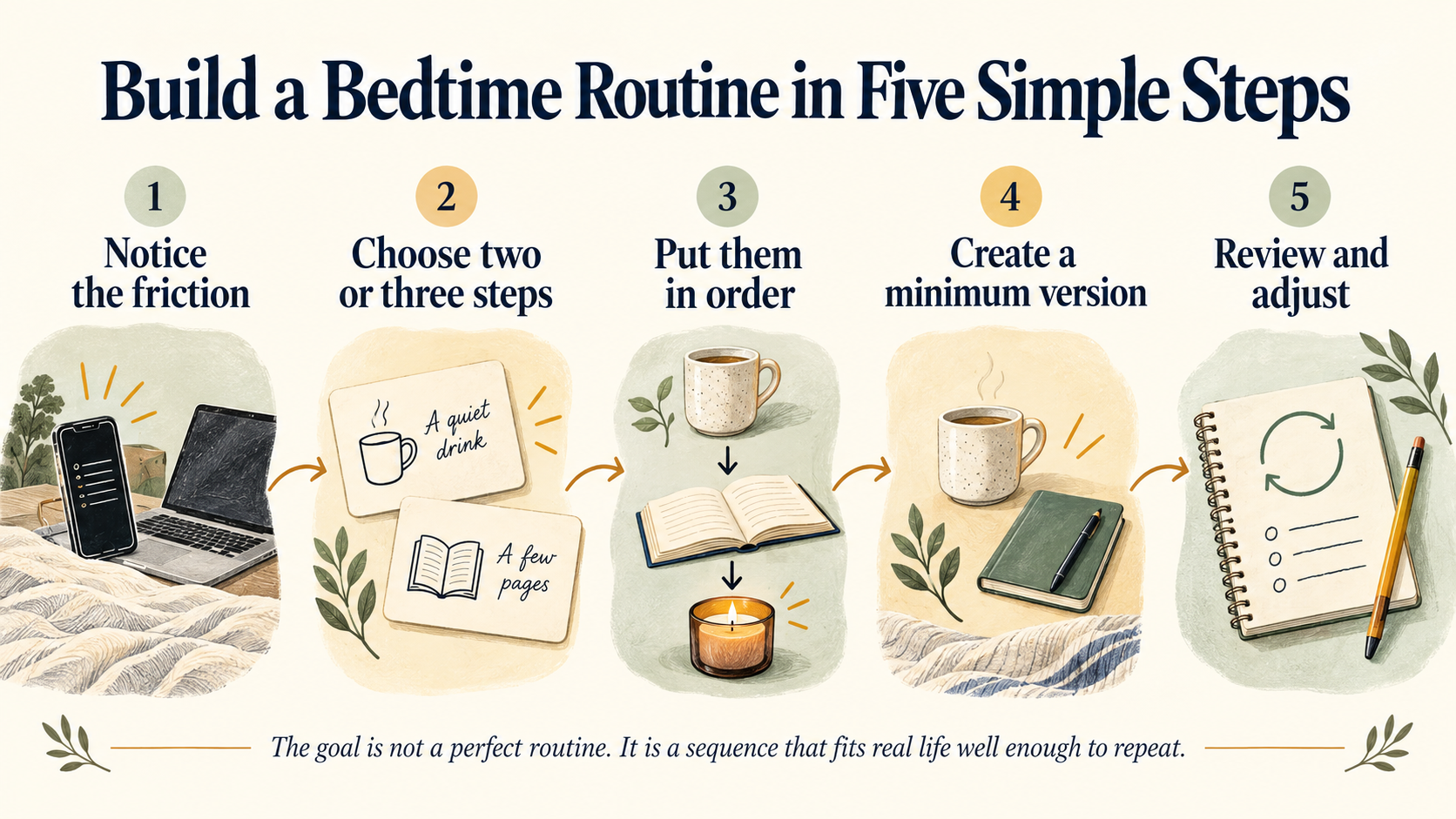
Step 1: Notice What Makes Your Evenings Harder
Before choosing any habits, identify what usually gets in the way.
You might lose track of time while scrolling, continue working later than planned, leave necessary tasks until the last minute, or have no clear signal that the active part of the day is over.
Ask yourself:
- What usually keeps me up later than planned?
- Which task feels most stressful near bedtime?
- What makes it difficult to stop working or scrolling?
- Which small change would make the evening feel less rushed?
Focus on the one problem that creates the most disruption. Your first routine does not need to address everything at once.

Step 2: Choose Two or Three Manageable Actions
Select a few actions that respond directly to the problem you identified.
A manageable action should be easy to remember, possible on most nights, and simple enough to complete when you are tired.
For example:
- If you lose track of time, use a clear stopping cue.
- If unfinished tasks occupy your attention, write down tomorrow’s first priority.
- If the morning often feels disorganized, set out one essential item.
- If your phone keeps you engaged, place it outside easy reach.
- If you want a quieter transition, read or choose another low-key activity.
Official sleep guidance commonly suggests quieter activities before bed, fewer electronic distractions, and a comfortable, dark, and quiet bedroom.
Match the Routine Step to the Evening Problem
| Evening challenge | Possible routine step | Minimum version |
|---|---|---|
| Losing track of time | Use a clear stopping cue | Set one reminder |
| Continuing to scroll | Place the phone outside easy reach | Turn it face down |
| Feeling unprepared for morning | Prepare essential items | Set out one item |
| Thinking about unfinished tasks | Write down tomorrow’s first priority | Note one task |
| Feeling too tired for several steps | Use a shorter sequence | Complete one closing action |
Step 3: Put the Steps in an Easy Order
Once you have chosen your actions, arrange them in a sequence that is easy to remember.
A simple order might include:
- A signal that evening tasks are ending.
- One practical preparation task.
- Basic hygiene.
- A quiet final activity.
- Moving toward bed without starting something new.
Example: Dim the lights, prepare tomorrow’s essentials, complete basic hygiene, and read for a few minutes.
Quieter time before bed and reduced exposure to bright artificial light are consistent with general recommendations from the National Heart, Lung, and Blood Institute.
You do not need to complete each action at the same exact minute. Aim for an order that feels familiar and easy to follow.
Step 4: Create a Minimum Version for Difficult Nights
Some nights will not leave enough time or energy for the full routine. A shorter backup version can prevent the evening from becoming an all-or-nothing decision.
The minimum version keeps only the steps that help you stop evening tasks and move toward bed.
Full version: Put the phone away, prepare for tomorrow, complete basic hygiene, and read for a few minutes.
Minimum version: Put the phone down, complete one necessary task, and move toward bed.
This is not a medical technique or a test of discipline. It is simply a practical way to make the routine easier to use on late workdays, during travel, or when responsibilities change unexpectedly.
Start here: Write down the smallest version of your routine that would still help you stop evening tasks and prepare for bed.

Step 5: Test the Routine and Adjust What Does Not Fit
Treat the first version as a draft.
Notice which steps are easy to repeat and which ones create more work. An action that consistently feels unrealistic may need to be shortened, moved, or removed.
Ask:
- Did the routine feel too long?
- Which step was easiest to repeat?
- Which step created more work?
- Did the sequence make the evening feel less rushed?
- What could be simplified?
Avoid setting a deadline for making the routine “stick.” Schedules, responsibilities, and preferences vary. The practical goal is to find a sequence that fits your evenings well enough to use regularly.
READ MORE:
How Much Sleep Do Adults Really Need?
Sleep Schedule Consistency: Common Questions, Mistakes, and Practical Tips
A Simple Bedtime Routine Example
A short bedtime routine for an adult might look like this:
- Put away work materials and lower the lights.
- Prepare one or two things for the morning.
- Complete basic hygiene.
- Read or choose another quiet activity.
- Move toward bed without starting another task.
This is only one example. Your routine may be shorter or longer depending on what fits your evening.
Reducing bright light, limiting electronic distractions, and choosing quieter activities are consistent with general sleep guidance.
A routine can help organize the end of the day, but it does not replace setting aside enough time for sleep.
Common Mistakes That Make Bedtime Routines Hard to Maintain
- Changing too many things at once. Start with a small number of actions rather than rebuilding the entire evening.
- Copying someone else’s routine exactly. A routine designed for another schedule or household may not fit yours.
- Making the routine too long. Remove steps that do not solve a real problem or make the evening easier.
- Treating one missed night as failure. Return to the routine at the next practical opportunity.
- Choosing steps that require too much effort. Make the action smaller before deciding it does not fit.
- Expecting the routine to solve a persistent sleep problem. General bedtime habits are not a substitute for professional evaluation or individualized care.
How to Keep Your Bedtime Routine Flexible
Weekends, travel, late workdays, caregiving, and social events can all change the timing of an evening.
When practical, preserve the basic sequence even if the routine begins later or becomes shorter. You might still close your laptop, prepare one morning item, complete basic hygiene, and go to bed while skipping a longer quiet activity.
General sleep guidance favors reasonably consistent sleep and wake times, but an exact schedule may not be realistic every day.
Shorten the Routine Without Replacing It
Keep the actions that provide the clearest transition and remove optional steps for that night.
After a disrupted evening, return to the regular version at the next practical opportunity.
When a Bedtime Routine May Not Be Enough
A bedtime routine can be part of general healthy sleep habits, but it is not a treatment for insomnia, sleep apnea, or another sleep disorder.
The CDC recommends speaking with a healthcare provider when you regularly have problems sleeping.
Loud snoring, gasping during sleep, breathing that stops and restarts, or excessive daytime sleepiness can also be reasons to seek professional guidance. These signs do not establish a diagnosis on their own.
When to get help: Persistent sleep problems or symptoms that interfere with daily life may require guidance from a qualified healthcare professional.
Frequently Asked Questions
How Long Should a Bedtime Routine Be?
There is no single duration that works for everyone. It should be long enough to provide a practical transition and short enough to fit your evening. Choose the steps first rather than starting with a target number of minutes.
Do I Need to Follow the Same Routine Every Night?
Not exactly. Keeping reasonably consistent sleep and wake times is common sleep guidance, but the exact timing and length of your routine may change. Try to preserve the general sequence when practical.
What Should I Do First in My Bedtime Routine?
Start with the part of the evening that creates the most friction. That might mean ending work, putting away your phone, preparing one morning item, or completing basic hygiene.
What If I Miss a Night?
Return to the routine at the next practical opportunity. You do not need to compensate by making the following night longer or more complicated.
Can a Bedtime Routine Help With Insomnia?
A bedtime routine can be part of general sleep habits, but it is not a treatment or guaranteed solution for insomnia. Persistent difficulty sleeping or functioning during the day is a reason to speak with a qualified healthcare professional.
Your Simple Bedtime Routine Checklist
- Identify the main source of evening friction.
- Choose two or three manageable actions.
- Put the actions in an easy order.
- Create a shorter version for difficult nights.
- Adjust what does not fit your schedule.
Start With a Routine That Fits Your Evening
The most useful bedtime routine is not the one with the most steps. It is the one that fits your evenings well enough to repeat.
Choose a small starting point, keep the order simple, and adjust the routine when life changes.
Start with two manageable steps tonight, keep the order simple, and adjust the routine when your schedule changes.
Medical note: This article provides general educational information about bedtime habits and is not a substitute for individualized medical care. Consider speaking with a qualified healthcare professional if sleep problems persist, interfere with daily life, or involve concerning breathing symptoms or excessive daytime sleepiness.
Sources
- National Heart, Lung, and Blood Institute — Healthy Sleep Habits
Used for consistent sleep schedules, quiet time before bed, bright artificial light, and bedroom environment.
https://www.nhlbi.nih.gov/health/sleep-deprivation/healthy-sleep-habits - MedlinePlus — Healthy Sleep
Used for consistent schedules, quiet activities, electronic distractions, and bedroom environment.
https://medlineplus.gov/healthysleep.html - Centers for Disease Control and Prevention — About Sleep
Used for guidance on speaking with a healthcare provider about sleeping problems.
https://www.cdc.gov/sleep/about/index.html - National Heart, Lung, and Blood Institute — Sleep Apnea Symptoms
Used for loud snoring, gasping, interrupted breathing, and daytime sleepiness.
https://www.nhlbi.nih.gov/health/sleep-apnea/symptoms - National Heart, Lung, and Blood Institute — What Is Sleep Apnea?
Used for guidance on discussing possible breathing-related sleep symptoms with a healthcare provider.
https://www.nhlbi.nih.gov/health/sleep-apnea - MedlinePlus — Sleep Disorders
Used to distinguish general sleep habits from the evaluation and care of sleep disorders.
https://medlineplus.gov/sleepdisorders.html