
Keeping a consistent sleep schedule is a common part of healthy sleep guidance. The CDC recommends going to bed and getting up at about the same time each day, and the National Heart, Lung, and Blood Institute (NHLBI) encourages keeping weekday and weekend schedules reasonably similar.
But consistency does not mean following the clock perfectly.
Late dinners, travel, family responsibilities, work schedules, and occasional poor nights all happen. A more useful goal is to build a sleep pattern that is reasonably predictable while still leaving enough time for sleep.
Here is what sleep schedule consistency means in practice, how much flexibility can be reasonable, what to do about weekends and late nights, and when an irregular schedule may deserve professional guidance.
Quick Takeaways
- A consistent sleep schedule generally means keeping bedtime and wake time reasonably similar from day to day.
- NHLBI suggests limiting weekday-to-weekend differences to about one hour when possible, but this is a practical guideline rather than a proven biological cutoff.
- Sleep regularity and adequate sleep both matter. A regular schedule should not routinely come at the expense of enough sleep.
- Persistent sleep problems or significant daytime sleepiness deserve more attention than simply trying to follow the clock more closely.
What Does a Consistent Sleep Schedule Actually Mean?
Sleep consistency, sometimes called sleep regularity, refers to how predictable your sleep timing is from one day to the next.
Research may look at differences in bedtime, wake time, sleep duration, or the timing of sleep across workdays and days off. A 2020 systematic review found that greater variability in sleep timing and duration was generally associated with less favorable health outcomes, although the quality of evidence varied across studies.
Sleep regularity is also different from sleep duration.
Someone can have a very regular schedule but consistently leave too little time for sleep. Another person might get enough sleep overall while changing bedtime and wake time substantially from day to day.
A healthy sleep routine therefore involves more than one factor: how much you sleep, when you sleep, how regular the pattern is, and how you function during the day.
Why Can Regular Sleep Timing Matter?
Your body has internal clocks that follow rhythms of roughly 24 hours. These circadian rhythms help coordinate periods of alertness and sleepiness.
Light and darkness are especially important signals. NHLBI explains that environmental cues help synchronize the body’s circadian clocks with the day-night cycle.
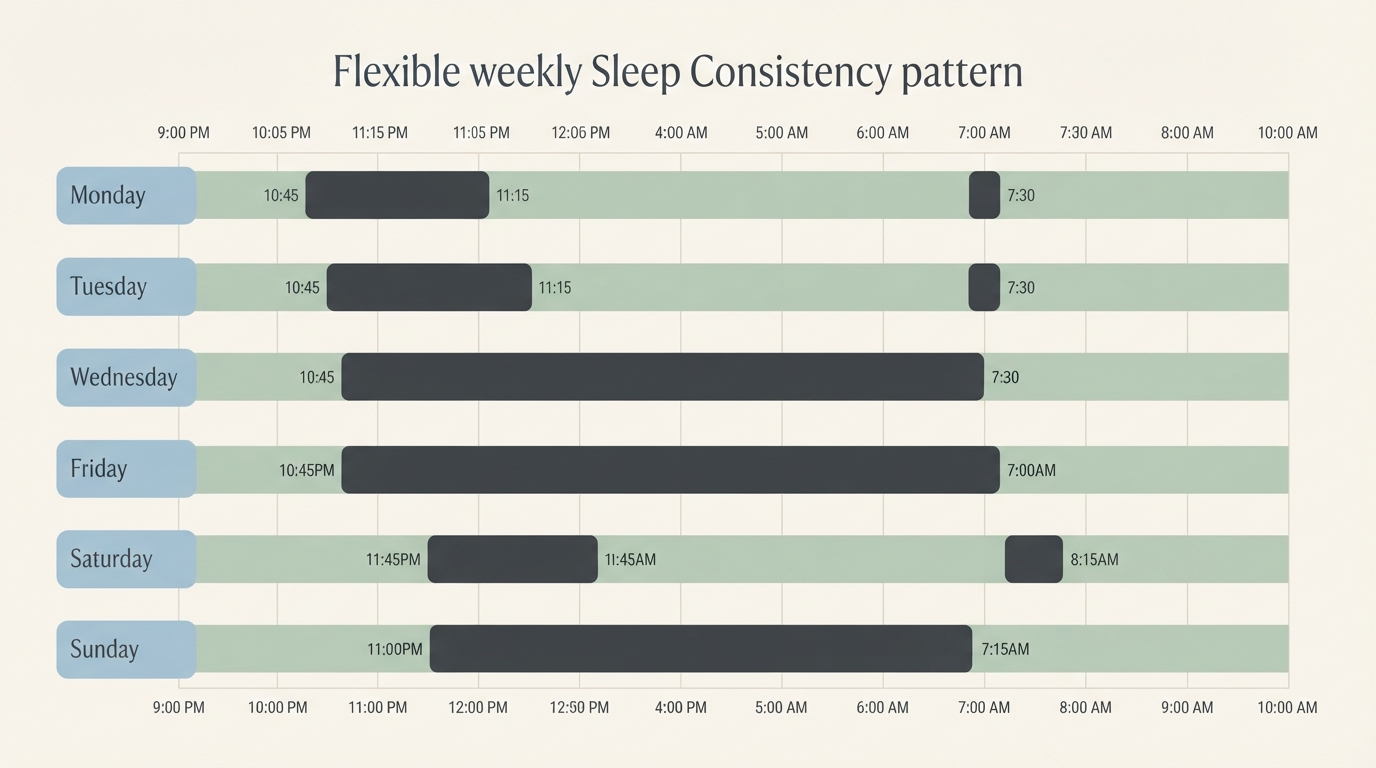
That does not mean one late bedtime “breaks” your body clock. Most research on sleep regularity looks at patterns over time rather than isolated nights.
Systematic reviews have found associations between greater sleep irregularity and less favorable health outcomes. A 2025 review also identified sleep regularity as an important dimension of sleep health while emphasizing the need for more randomized intervention research.
So the safest takeaway is modest: a reasonably predictable schedule can be one useful part of healthy sleep habits, but the evidence does not support treating every variation as harmful.
How Consistent Should Your Sleep Schedule Be?
There is no scientifically established rule saying your bedtime or wake time must stay within an exact number of minutes every day.
NHLBI recommends keeping weekday and weekend sleep schedules similar and limiting the difference to about one hour when possible.
That is a useful practical reference, not a strict biological boundary.
The 2020 systematic review on sleep timing and consistency found that available evidence was not sufficient to establish a universal threshold for what should count as “large” sleep variability.

Keep in mind: “About one hour” is a practical guideline, not a proven line separating a healthy schedule from an unhealthy one.
An occasional late night or weekend change is different from a schedule that shifts by several hours over and over. It makes more sense to look at your overall pattern than to judge individual nights as successes or failures.
Is It Okay to Sleep In on Weekends?
Yes, sometimes.
Advice about sleep consistency can become too rigid when it ignores another basic need: getting enough sleep.
A 2023 National Sleep Foundation consensus panel concluded that regular sleep timing is important for health, safety, and performance. The same panel also concluded that when someone gets insufficient sleep during workdays, sleeping longer on weekends or other non-work days may be beneficial.
So “never sleep in” is too simplistic.

At the same time, regularly shifting your schedule by several hours between workdays and days off can reduce overall sleep regularity. NHLBI describes large differences between workday and free-day timing as part of what is commonly called social jet lag. Social jet lag itself is not classified as a sleep disorder.
| Situation | Practical perspective | Important nuance |
|---|---|---|
| You sleep later after an unusually short night | Extra sleep may be reasonable | One unusual night is not the same as a chronically irregular schedule |
| Your schedule shifts several hours every weekend | It may be worth reviewing the pattern | Repeated large shifts reduce regularity |
| You regularly sleep too little on workdays | Consistency is not the only issue | Your routine also needs to leave enough opportunity for sleep |
| You need catch-up sleep most weekends | Look at the weekday routine | Repeated catch-up sleep may signal that weekday sleep is insufficient |
The goal is not to avoid every extra hour of sleep. It is to avoid turning chronic sleep restriction into a routine that depends on weekends to compensate.
READ MORE:
Simple Relaxation Techniques to Try Before Bed
How to Keep a More Consistent Sleep Schedule Without Making Life Rigid
What Should You Do After a Late Night?
One off-schedule night usually does not require a dramatic “reset.”
A practical response is to:
- Return toward your usual routine when it is realistic.
- Protect enough time for sleep rather than focusing only on the clock.
- Avoid turning one unusual night into several days of large schedule shifts.
- Resume familiar daytime and bedtime cues. Regular wake times, daytime activity, appropriate light exposure, and a familiar wind-down routine can support a more predictable sleep pattern.
If you need extra sleep after a short night, do not treat that as a failure. If you find yourself needing substantial catch-up sleep most weekends, it may be more useful to examine whether your weekday schedule leaves enough time for sleep.
Common Sleep Schedule Mistakes
A few common habits can make sleep consistency harder than it needs to be.
- Treating consistency as perfection. Exact timing every night is not required by the evidence.
- Sacrificing sleep to hit an exact wake time. A predictable schedule does not replace adequate sleep. The CDC recommends at least seven hours per day for adults ages 18 to 60, with age-specific recommendations for older adults.
- Making weekdays and weekends completely different schedules. Some flexibility is normal, but repeated large shifts can reduce regularity.
- Assuming everyone needs the same bedtime. People naturally vary in sleep timing. Some tend to sleep earlier, while others tend to run later.
- Treating an irregular week as a medical diagnosis. An inconsistent schedule alone does not establish insomnia, a circadian rhythm disorder, or another sleep condition.
The useful target is a routine that fits your responsibilities while still allowing enough opportunity to sleep.
What If Your Schedule Cannot Be the Same Every Day?
Not everyone has full control over sleep timing.
Night shifts, rotating shifts, caregiving, travel, and changing work demands can make a perfectly consistent schedule unrealistic. In those situations, aim for predictability where you realistically can rather than trying to meet an ideal that does not fit your life.
For shift workers, NHLBI recommends limiting frequent changes between day and night shifts when possible. It also notes that keeping some overlap between workday and non-workday sleep periods may help reduce repeated schedule changes.
Protecting enough time for sleep and reducing disruptive light and noise during daytime sleep can also be useful parts of a shift-work routine.
If work schedules repeatedly prevent adequate sleep or you have significant difficulty adapting to shifts, professional guidance may be helpful.
When Should You Talk With a Healthcare Professional?
An irregular sleep schedule is not automatically a medical problem. What matters more is whether sleep difficulties are persistent or interfere with daily functioning.
Consider talking with a qualified healthcare professional if you:
- often feel excessively sleepy during the day;
- regularly wake feeling unrefreshed despite having enough opportunity to sleep;
- have ongoing difficulty falling asleep or staying asleep;
- struggle significantly with a shift-work schedule; or
- have sleep problems that interfere with work, driving, concentration, or everyday activities.
Frequent loud snoring, repeated breathing pauses during sleep, or waking while gasping for air also deserve medical attention. These symptoms can occur with sleep apnea, but symptoms alone do not establish a diagnosis.
Medical note: This article provides general educational information and is not a substitute for individualized medical advice. Talk with a qualified healthcare professional if sleep problems are persistent, cause significant daytime sleepiness, or interfere with daily life.
A Realistic Goal: Consistency, Not a Perfect Clock
A useful sleep schedule is predictable enough to support your routine but flexible enough to fit real life.
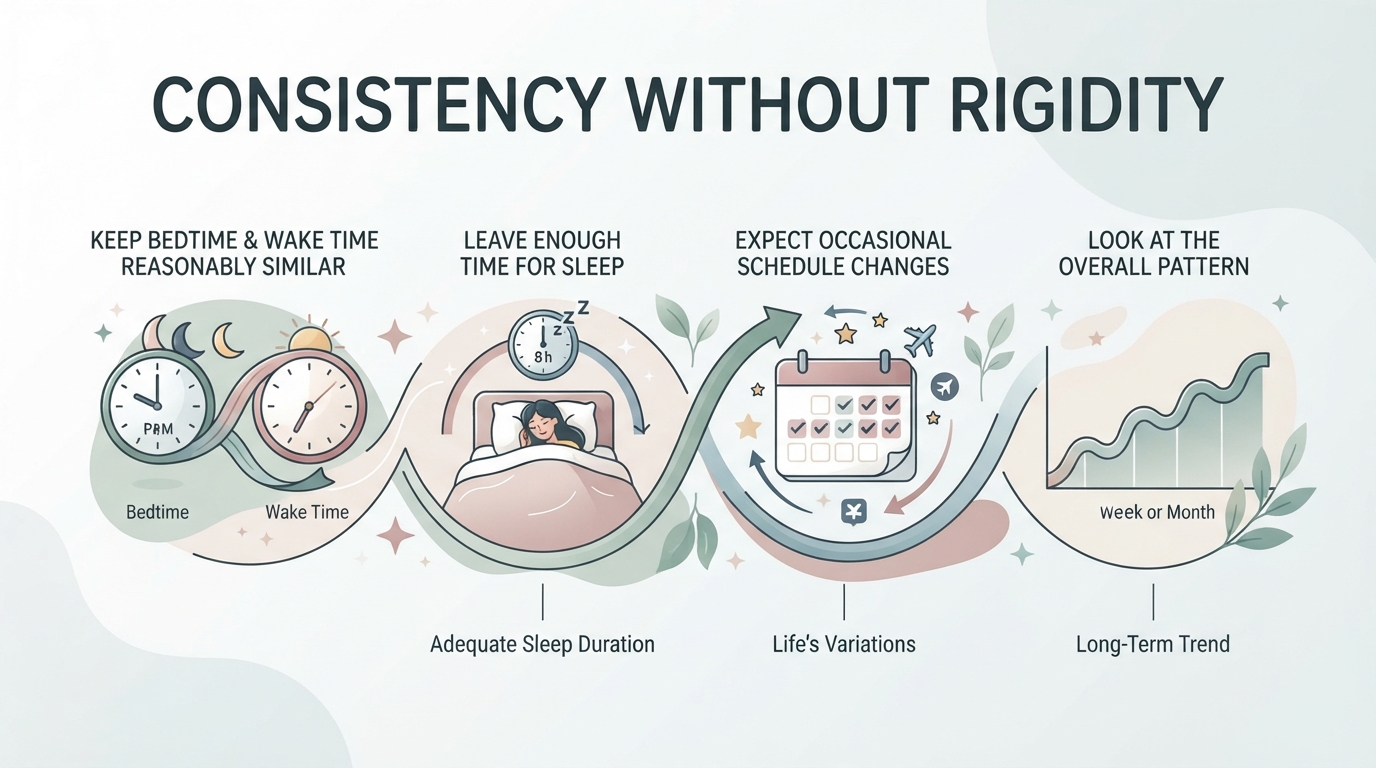
Try to keep your bedtime and wake time reasonably similar, protect enough time for sleep, and pay attention to repeated patterns rather than judging one unusual night.
Sleep schedule consistency is one part of healthy sleep—not a competition to follow the clock perfectly.
CTA: Choose one manageable timing habit to focus on first, and adjust it as your schedule changes.
Sources
- Centers for Disease Control and Prevention — About Sleep
https://www.cdc.gov/sleep/about/ - National Heart, Lung, and Blood Institute — Healthy Sleep Habits
https://www.nhlbi.nih.gov/health/sleep-deprivation/healthy-sleep-habits - National Heart, Lung, and Blood Institute — Your Sleep/Wake Cycle
https://www.nhlbi.nih.gov/health/sleep/sleep-wake-cycle - Chaput et al. — Sleep timing, sleep consistency, and health in adults: a systematic review
https://pubmed.ncbi.nlm.nih.gov/33054339/ - Sletten et al. — The importance of sleep regularity: a consensus statement of the National Sleep Foundation sleep timing and variability panel
https://pubmed.ncbi.nlm.nih.gov/37684151/ - Sleep Medicine Reviews — Sleep regularity as an important component of sleep hygiene: a systematic review
https://pubmed.ncbi.nlm.nih.gov/41259946/ - National Heart, Lung, and Blood Institute — Circadian Rhythm Disorders: Causes and Risk Factors
https://www.nhlbi.nih.gov/health/circadian-rhythm-disorders/causes - National Heart, Lung, and Blood Institute — Circadian Rhythm Disorders: Types
https://www.nhlbi.nih.gov/health/circadian-rhythm-disorders/types - National Heart, Lung, and Blood Institute — Sleep Apnea Symptoms
https://www.nhlbi.nih.gov/health/sleep-apnea/symptoms