
You want to get stronger, but your living room doubles as your office, the bedroom barely fits your furniture, and you don’t own a single dumbbell. It’s easy to assume that strength training requires more space, more equipment, or a more organized schedule than you currently have.
Fortunately, strength training at home doesn’t have to begin with a perfect workout space. A clear section of floor, a sturdy wall, and a few movements suited to your abilities can provide a reasonable starting point.
The challenge is knowing what to do with those limited resources. Which exercises are worth considering? How can you work different muscles without machines? And how do you make your routine more challenging without turning your home into a gym?
This guide focuses on those practical decisions, so you can build a manageable approach around the space and abilities you have today.
What You Actually Need to Start Strength Training at Home
Strength training works by asking your muscles to produce force against resistance. That resistance might come from a dumbbell, an exercise machine, or your own body weight.
The important distinction is that a muscle-strengthening activity challenges the muscles involved. Simply moving your arms or changing positions does not necessarily provide enough resistance to develop strength.
The U.S. Physical Activity Guidelines recognize bodyweight exercises, including push-ups and other forms of calisthenics, as muscle-strengthening activities. They also recommend working the major muscle groups rather than focusing on one area alone. [1]
That means a home routine doesn’t necessarily require specialized equipment. However, having no equipment and having no plan are two different things.
A useful starting point involves three basic considerations:
- Movements that challenge different areas of your body.
- A level of difficulty that matches your current abilities.
- Enough regularity to practice and gradually adjust those movements.
You also need a reasonably safe environment and the ability to perform your chosen exercises with control.
The American College of Sports Medicine’s 2026 position stand emphasizes progressive resistance training and recognizes that different training approaches can improve muscle function. It does not establish one perfect routine for everyone. [2]
For someone exercising at home, that flexibility is valuable. Your routine can be simple without being thoughtless, and it can evolve without requiring an immediate purchase.
Make a Small Space Work Before You Move
Before choosing exercises, look at the area where you’ll practice.
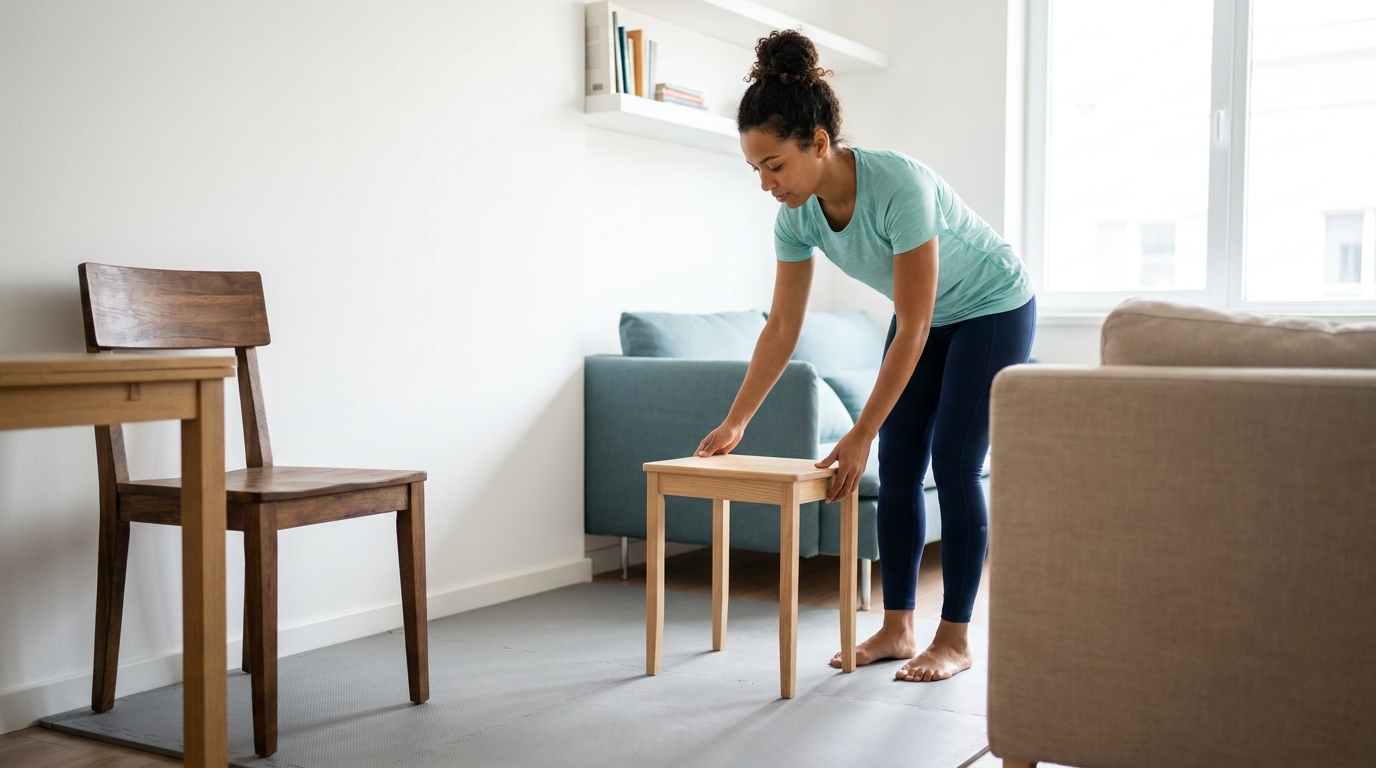
You don’t necessarily need enough room to lie down, stretch your arms in every direction, or move freely across the floor. Some strength exercises can be performed almost entirely while standing.
What matters is whether you can complete each movement without hitting furniture, losing your footing, or relying on something unstable.
Start by moving loose objects out of the way. Electrical cords, small rugs, toys, and clutter can become tripping hazards, particularly when you’re concentrating on a new exercise.
Next, consider the surface beneath your feet. A firm, non-slip floor is generally preferable to an uneven or slippery area. Comfortable clothing that allows movement and footwear appropriate for the activity can also help.
If you’re using a wall for support, choose a solid, unobstructed surface. If you plan to use a chair, make sure it is sturdy, does not roll, and will not slide when you place weight on it.
Avoid treating household furniture as exercise equipment simply because it happens to be nearby. A lightweight table, movable shelf, or unsecured door may not tolerate the forces involved.
Lighting, temperature, and ventilation matter too. A cramped corner that becomes uncomfortably hot or leaves you unable to move comfortably may not be a suitable place to exercise.
Try a few gentle movements before beginning. Can you stand comfortably, bend your knees, and extend your arms in the intended direction without striking anything?
There is no universal minimum room size for every home workout. Your space needs depend on the movements you choose, your body, and whether you require additional support or mobility aids.
For many people, the more practical solution is to adapt the exercises to the room, rather than rearrange the entire room around the exercises.
Choose Movements That Cover More Than One Muscle Group
A common problem with strength training without equipment is choosing whatever exercises look familiar.
Someone might do several sets of squats and push-ups, feel they’ve completed a full workout, and overlook other important muscles.
A more balanced approach considers the different actions your muscles perform.
The CDC identifies the legs, hips, back, abdomen, chest, shoulders, and arms among the major muscle groups that muscle-strengthening activities should address. [3]
You don’t need a separate exercise for every individual muscle. Many movements involve several areas at once.
Start With Lower-Body Movements
Your legs and hips play a major role in everyday actions such as standing up, climbing stairs, and getting out of a car.
A sit-to-stand exercise is one possible starting point.
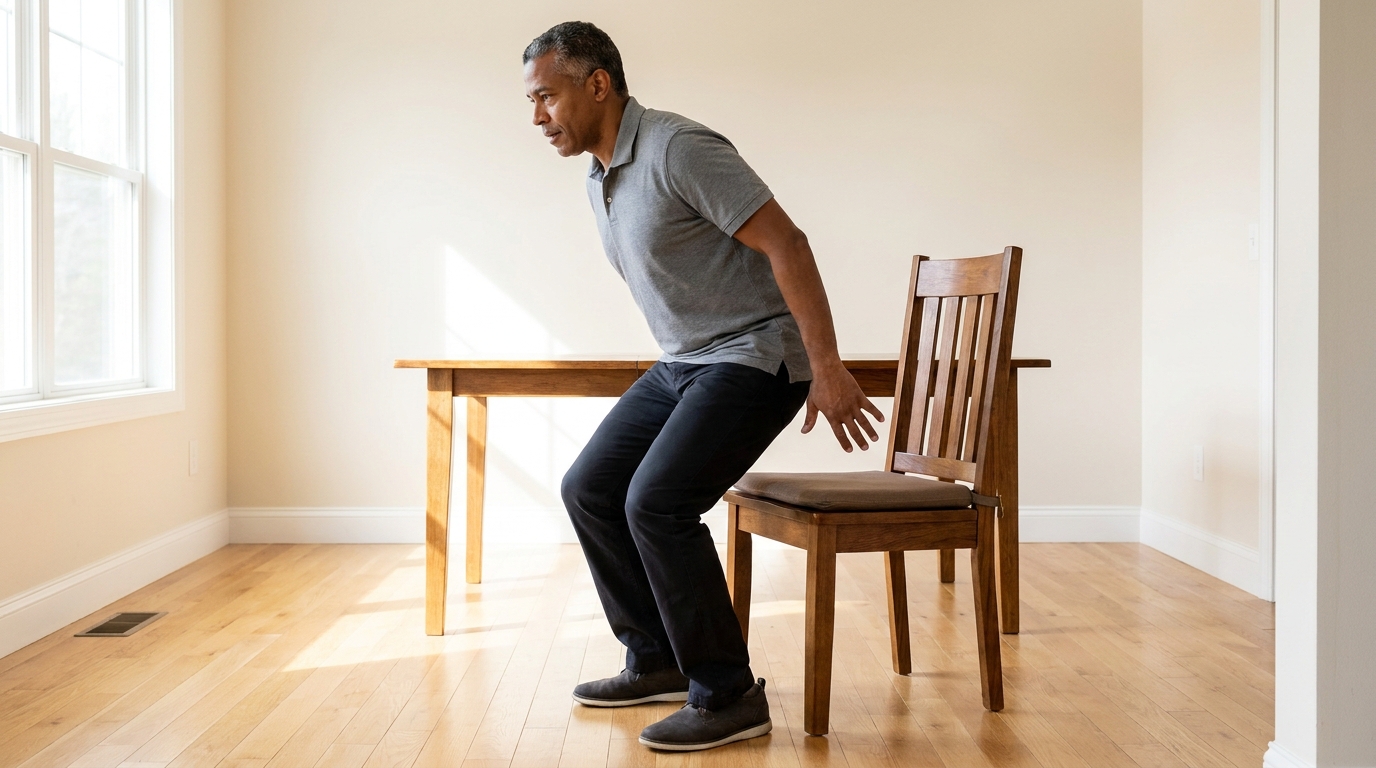
Sit on a stable chair with your feet comfortably positioned on the floor. If you can do so safely, lean forward slightly from your hips, press through your feet, and rise to standing. Lower yourself back to the chair with control.
The goal isn’t to stand as quickly as possible. It’s to practice a controlled movement within your comfortable range.
Some people may need to use their hands or an appropriate support. Others might find the movement too easy and eventually consider a more challenging squat variation.
Chair height, balance, mobility, and existing joint problems can substantially change how difficult this exercise feels.
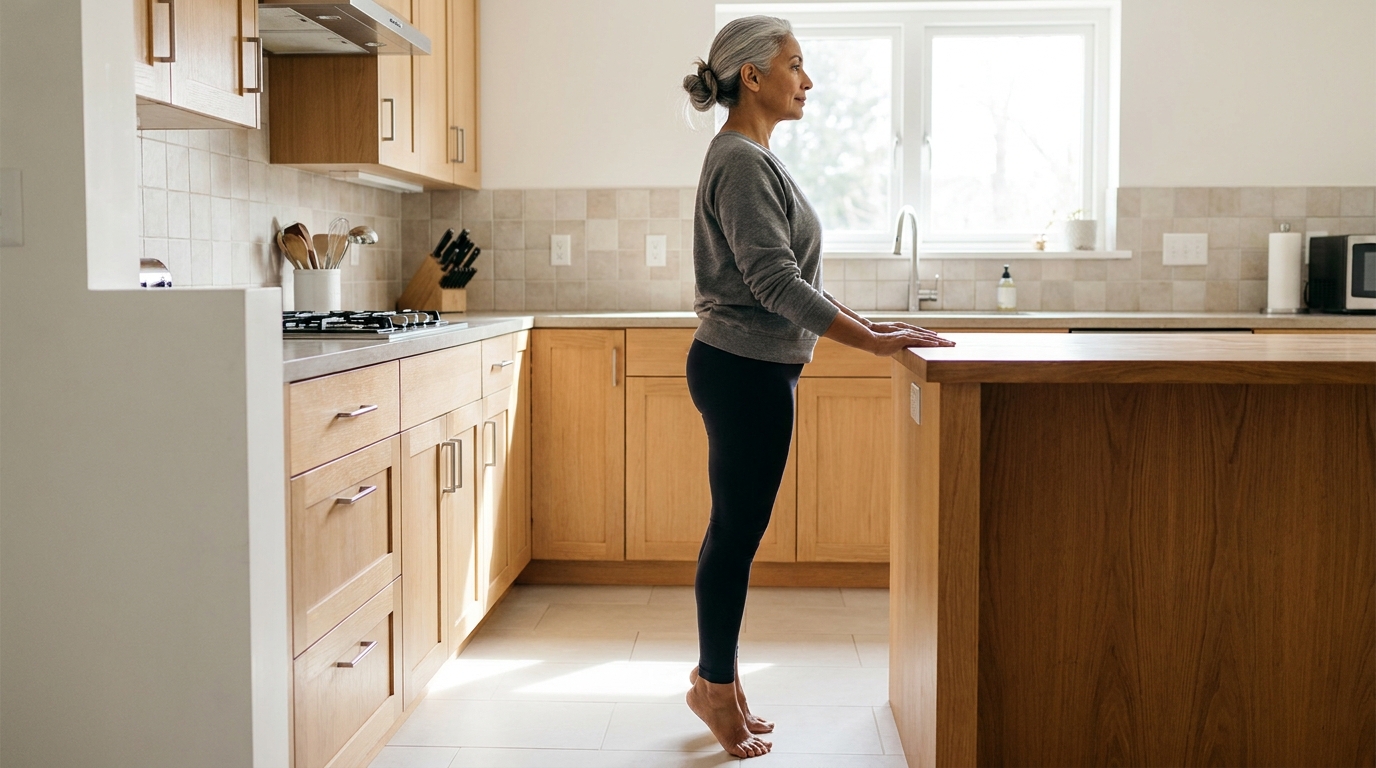
A supported calf raise is another possible movement. Standing near a secure surface, you slowly lift your heels and lower them again. It mainly targets the calf muscles and may be useful as part of a broader lower-body selection.
Neither movement is appropriate for everyone, and neither independently provides complete lower-body training.
Add an Upper-Body Push
Pushing movements involve muscles of the chest, shoulders, and arms.
A wall push-up provides a way to explore this movement without getting on the floor.
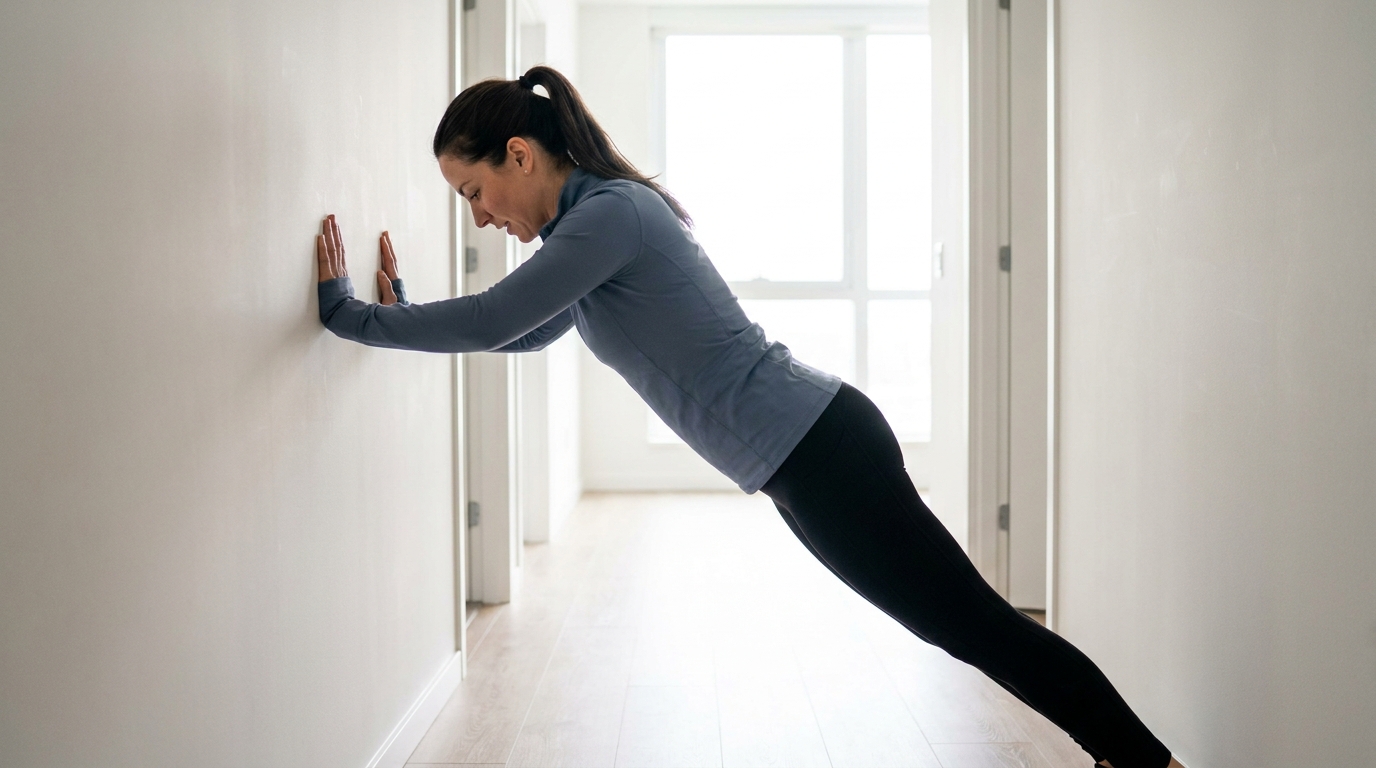
Stand facing a sturdy wall and place your hands against it at approximately chest height. Step back to a comfortable position, keeping your feet secure.
With your body reasonably aligned, bend your elbows to bring your chest toward the wall. Then press away smoothly.
You can adjust the challenge by changing your distance from the wall, provided you maintain control and avoid shoulder or wrist discomfort.
Wall push-ups are not automatically effortless. The right level of difficulty depends on your strength, body position, and mobility.
There’s also no need to move through an uncomfortable range simply to imitate a demonstration.
READ MORE:
10 Evening Habits That May Make It Easier to Wind Down
How to Create a Sleep-Friendly Bedroom Without Spending Much
Don’t Forget Your Back and Trunk
This is where equipment-free training becomes less straightforward.
Your back muscles perform different jobs, including helping pull your arms toward your body and supporting movement of the shoulders and torso.
Push-ups do not replace pulling exercises, even though both involve the upper body.
A controlled hip-hinge movement is one way to explore how your hips and trunk work together. Stand with your feet comfortably apart, soften your knees, and gently move your hips backward while keeping your back in a comfortable, controlled position. Return to standing without rushing.
This movement may help you practice an important pattern used in daily activities. Depending on your capabilities and the resistance involved, however, an unloaded hip hinge may provide little strength-building challenge.
For your abdominal muscles, a controlled trunk-bracing exercise can introduce the idea of keeping your torso steady during movement. You can practice gently tightening the muscles around your midsection while breathing normally, without holding your breath or pushing into pain.
These are useful movement skills, but they are not automatically substitutes for progressive resistance training.
Upper-body pulling is a particular challenge when you have no equipment. Exercises such as rows normally require something to pull against, and ordinary posture drills do not necessarily create comparable resistance.
If you’re not able to perform a suitable pulling exercise safely, it is better to acknowledge that gap than improvise one using an unstable object.
A qualified exercise professional can help you find an appropriate alternative based on your abilities and available resources. An inexpensive resistance option may eventually become useful, but purchasing one is not a requirement for taking your first steps toward a home routine.
The key is understanding the difference between practicing movement patterns and strengthening every major muscle group.
You can begin with accessible exercises while recognizing that your program may need to become more complete over time.
Avoid improvising pulling exercises with door handles, unstable tables, unsecured towels, or furniture that could tip over.
The objective is to build a safer, more balanced routine, not to force every possible exercise into your home immediately.
Put Together a Routine You Can Repeat
Once you’ve considered your space and the movements available to you, the next step is organizing a manageable session.
You don’t have to begin with a complicated schedule.
Start with several minutes of comfortable movement to prepare your body. This might involve easy walking around the room or gentle movements of the joints you’ll be using.
Then select a small number of strength exercises that are appropriate for your abilities.
For an adult who can perform these movements safely, an illustrative starting session might look like this:
- Begin with a gentle warm-up, such as easy walking and comfortable joint movements.
- Practice controlled sit-to-stands or an appropriate lower-body alternative.
- Perform wall push-ups or another suitable upper-body pushing movement.
- Include a different lower-body action, such as supported calf raises, if appropriate.
- Practice a comfortable hip hinge or trunk-control movement, recognizing that it may develop movement skills without providing substantial resistance.
- Include an appropriate pulling exercise if you have a safe way to create sufficient resistance. Otherwise, identify it as an area to address with further guidance.
- Finish by moving gently and allowing your breathing to settle.
This sequence demonstrates how to organize different types of movement. It is not a complete or individualized full-body workout prescription.
It also illustrates an important distinction: a routine that helps you become comfortable with exercise may not yet provide enough resistance to strengthen every major muscle group.
The CDC describes 8 to 12 repetitions as a common approach for a set of strengthening exercises and notes that additional sets may provide further benefits. [3]
However, the repetition count alone doesn’t determine whether an exercise is effective.
If you can complete a movement repeatedly without meaningful muscular effort, that version may not offer much strength-building stimulus for you. Conversely, a movement that makes you lose control or produces concerning discomfort may be too demanding.
Those numbers are helpful reference points, not requirements that override your abilities. A movement may need to be modified, or a different exercise chosen, if you cannot perform it comfortably and with control.
Rest between exercises as needed. You should generally be able to breathe normally and maintain good technique rather than rush through repetitions.
As for frequency, U.S. guidelines recommend muscle-strengthening activities involving all major muscle groups on at least two days each week. [1]
If you’re returning after a long period of inactivity, you may need to build toward that recommendation gradually. A qualified professional can help when you’re unsure how to begin safely.
Remember that the familiar recommendation of 150 minutes of moderate aerobic activity each week is separate from the recommendation for muscle-strengthening exercise.
Walking and other aerobic activities have important benefits, but they don’t automatically replace deliberate resistance training.
A walking routine can complement your strength exercises, helping you include different forms of movement throughout the week.
Your practical goal is to create a routine you can return to, while allowing appropriate recovery between demanding sessions for the same muscles.
Make It Easier or Harder Without Buying Equipment
A home exercise that feels difficult today may feel easier after you’ve practiced it for a while.
That’s not a reason to immediately replace your routine.
Instead, consider whether you can change one aspect of the movement to create a suitable new challenge.
This idea relates to progressive overload, a principle of resistance training in which the demands on your muscles increase as your capabilities develop.
Research summarized by the ACSM supports progressive resistance training for improving muscle function, while recognizing that training variables can be adjusted according to individual goals. [2]
In practice, progression can take several forms.
You might perform an additional controlled repetition, add another set, or choose a more challenging version of an exercise. In some movements, changing body position or increasing the working range can increase the demands.
For example, someone who has become comfortable with a particular wall push-up position might adjust their stance to make the movement more demanding, provided their technique remains controlled.
Progression doesn’t mean making every session harder.
You may need to maintain the same challenge for several sessions, reduce it temporarily, or rest when recovery is insufficient.
Similarly, exercising until you cannot complete another repetition is not a universal requirement. The ACSM’s 2026 evidence review did not find that training to momentary muscle failure consistently improved the outcomes examined. [2]
Pay attention to the difference between muscular effort and problematic discomfort.
Working muscles may feel challenged or tired. Sharp pain, worsening joint pain, dizziness, or unusual symptoms are not signals to push harder.
If an exercise repeatedly causes discomfort, reconsider the movement rather than simply trying to tolerate it.
You can also make an exercise easier by using a more supported position, reducing its range, decreasing repetitions, or selecting a less demanding alternative.
The most useful progression is the one you can perform safely and sustain.
When Home Workouts Need Extra Caution
Being at home doesn’t make an exercise automatically safe for every person.
Your current health, balance, mobility, previous injuries, and experience can affect which movements are appropriate.
If you have a chronic medical condition, a recent injury, ongoing joint pain, or significant physical limitations, ask a qualified health professional about suitable activities and modifications.
The National Institute on Aging notes that many people with chronic conditions can benefit from physical activity, but their plans may require individual adjustments. [4]
That doesn’t mean every healthy adult needs medical clearance before ordinary moderate physical activity. NIH guidance indicates that generally healthy people without heart problems typically do not need a doctor’s approval before beginning moderate-intensity exercise. [5]
However, symptoms deserve attention.
Stop exercising if you experience chest pain, severe or unusual shortness of breath, significant dizziness, or another concerning symptom. Seek urgent medical evaluation when appropriate. If symptoms suggest a medical emergency, call 911 in the United States. [6]
Persistent pain, swelling, or symptoms that repeatedly appear during exercise also warrant professional assessment rather than continued experimentation. [4]
If balance is a concern, avoid unsupported exercises that could lead to a fall. A physical therapist or appropriately qualified exercise professional may help identify safer alternatives.
Exercise should challenge your muscles, but it should not require you to ignore important warning signs.
Your First Setup Doesn’t Have to Be Your Final One
Your first home strength-training routine might consist of a few movements performed beside a wall or sturdy chair.
It may not cover every muscle group perfectly. It may need adjustments after the first several sessions. And some exercises may eventually require a different form of resistance to provide an appropriate challenge.
None of those limitations makes the starting effort meaningless.
What matters is recognizing what your routine currently does, what it leaves out, and how you can improve it without sacrificing safety.
Choose a space that works. Find movements that suit your abilities. Give yourself room to practice before making them more demanding.
As your confidence and physical capabilities change, you can revisit your exercise selection and seek guidance where necessary.
A dedicated workout room might be convenient, but it isn’t the foundation of strength training. An appropriate challenge, a workable routine, and gradual progression matter far more than having an impressive setup.
Medical Note
This article is for general educational purposes and is not a substitute for personalized medical advice, diagnosis, treatment, or exercise prescription. If you have a medical condition, injury, persistent pain, or concerns about exercising safely, consult a qualified healthcare professional. Stop exercising and seek appropriate medical attention if you experience concerning symptoms.
Sources
[1] U.S. Department of Health and Human Services. Physical Activity Guidelines for Americans, 2nd Edition. 2018.
https://odphp.health.gov/sites/default/files/2019-09/Physical_Activity_Guidelines_2nd_edition.pdf
[2] Currier BS, D’Souza AC, Fiatarone Singh MA, et al. American College of Sports Medicine Position Stand: Resistance Training Prescription for Muscle Function, Hypertrophy, and Physical Performance in Healthy Adults: An Overview of Reviews. Medicine & Science in Sports & Exercise. 2026;58(4):851–872.
https://doi.org/10.1249/MSS.0000000000003897
[3] Centers for Disease Control and Prevention. What Counts as Physical Activity for Adults.
https://www.cdc.gov/physical-activity-basics/adding-adults/what-counts.html
[4] National Institute on Aging. Exercising With Chronic Conditions. National Institutes of Health.
https://www.nia.nih.gov/health/exercise-and-physical-activity/exercising-chronic-conditions
[5] National Heart, Lung, and Blood Institute. Physical Activity and Your Heart: Getting Started and Staying Active. National Institutes of Health.
https://www.nhlbi.nih.gov/health/heart/physical-activity/stay-active
[6] National Institute of Diabetes and Digestive and Kidney Diseases. Staying Active at Any Size. National Institutes of Health.
https://www.niddk.nih.gov/health-information/weight-management/staying-active-at-any-size