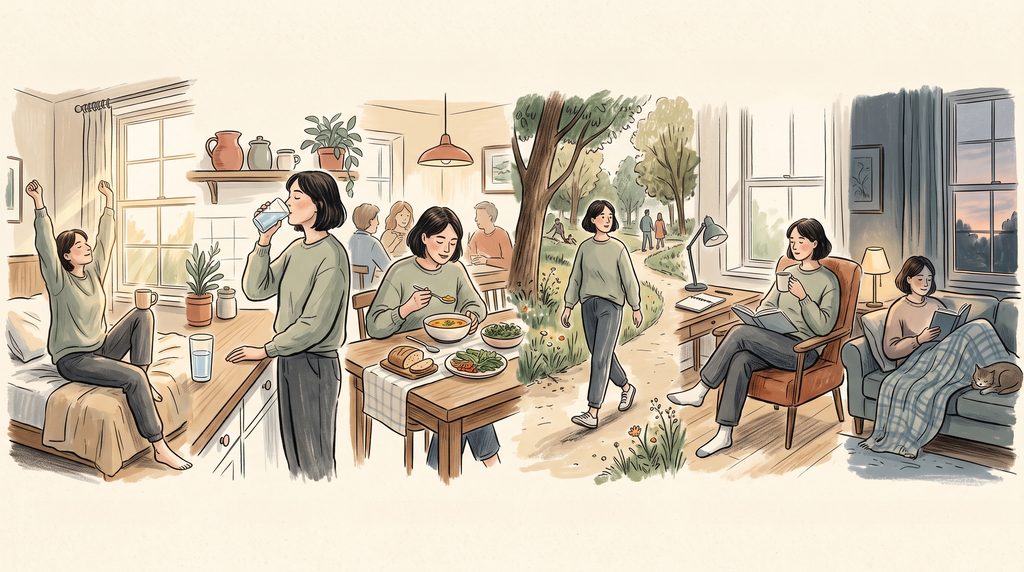
After several days, start with what your notes actually show rather than trying to explain every change.
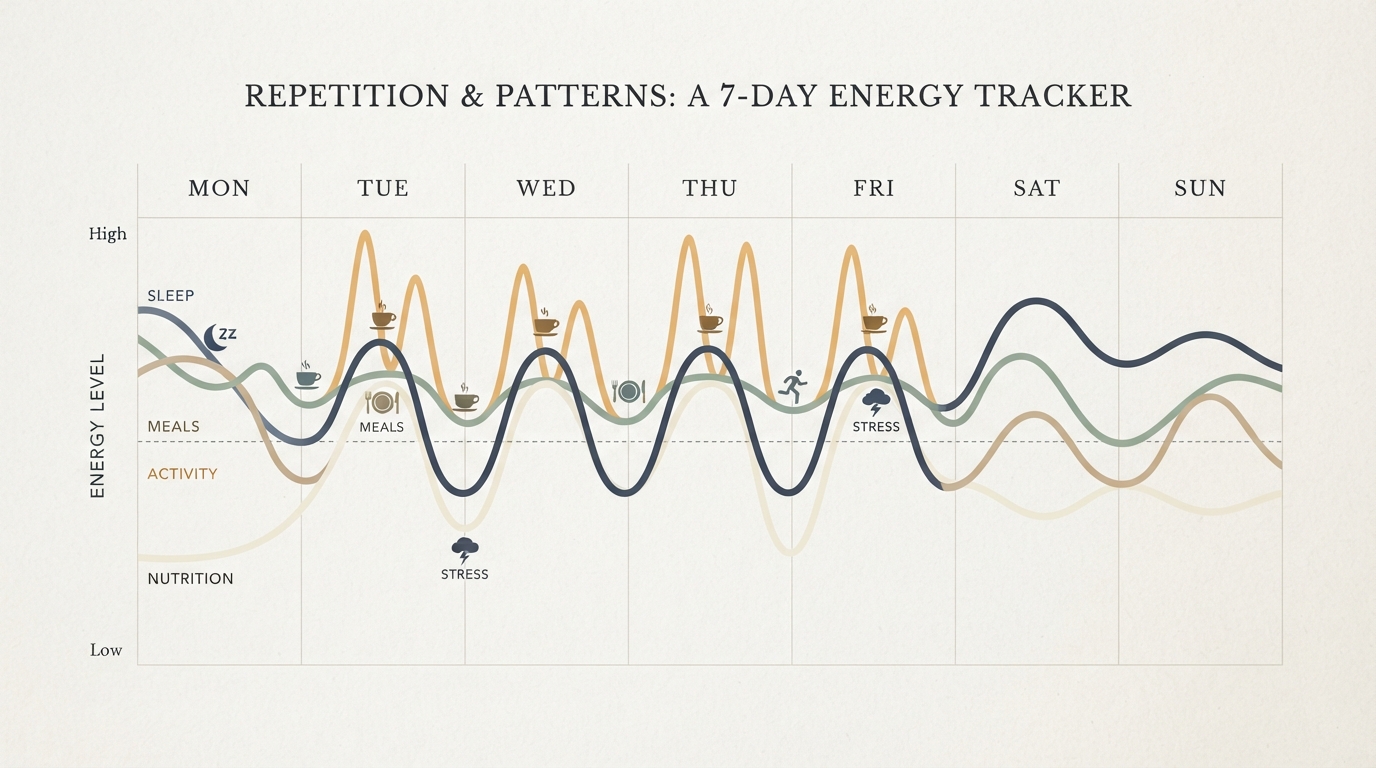
Look for repetition
Ask questions such as:
- Do lower ratings tend to appear at a similar time?
- Do they show up more often after nights when you slept less?
- Does sleepiness seem more noticeable when your schedule changes?
- Do certain habits repeatedly appear alongside the same pattern?
A useful observation might be:
“On several days when I went to bed later than usual, I also rated my morning energy lower.”
That describes your notes. It does not prove what caused the difference.

Association is not the same as cause
Daily habits rarely change one at a time.
After a short night, you might drink more caffeine, move less, eat at different times, and face a more demanding workday. If your energy drops later, your diary cannot tell you with certainty which factor was responsible.
Treat repeated associations as clues worth noticing, not diagnoses or proof of cause.
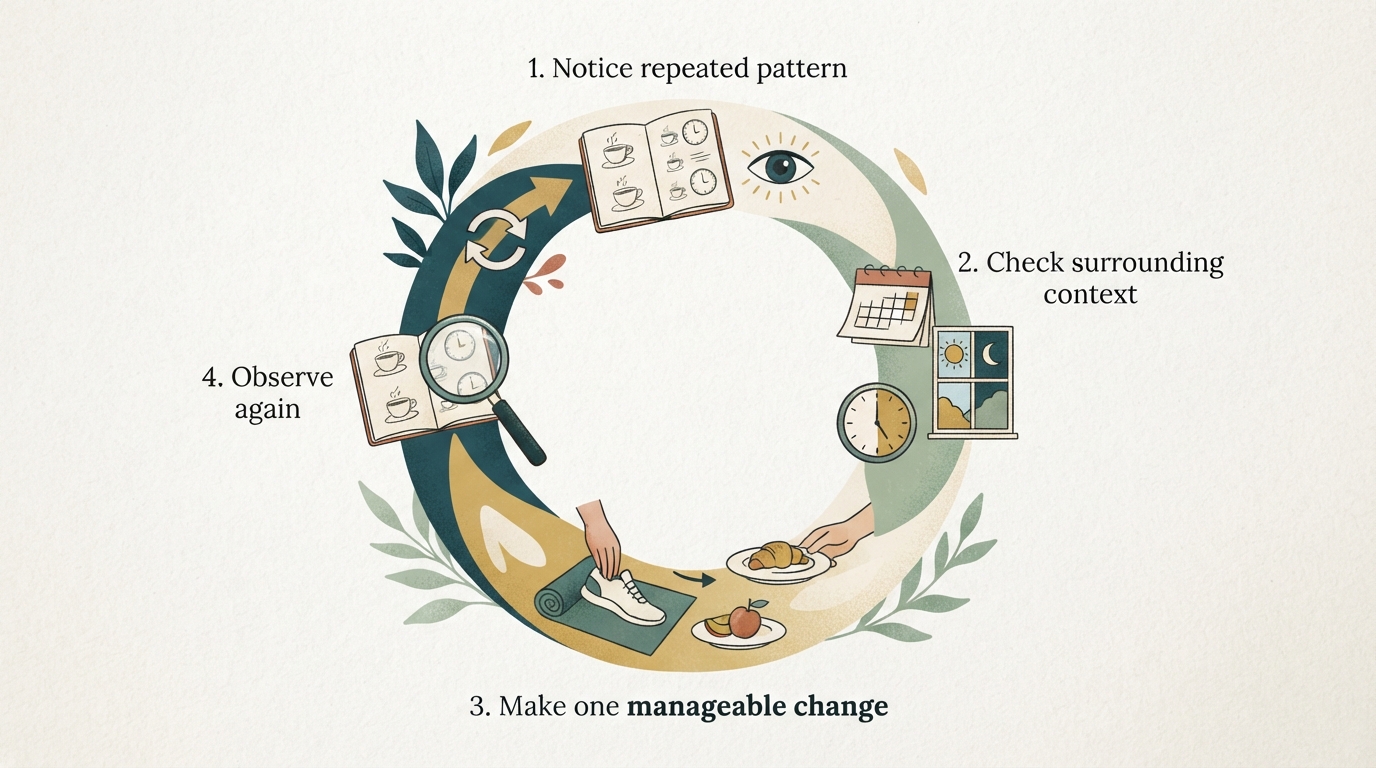
Try one manageable change
If a pattern seems reasonably consistent, consider one safe, practical adjustment at a time.
Notice the pattern → Check the context → Make one manageable change → Observe again
Keeping the change simple can make your next set of observations easier to interpret.
Everyday Factors Worth Noticing
You do not need to track every possible influence. Focus on factors that actually vary in your routine.
Sleep duration, quality, and timing
Sleep is one of the most useful areas to compare with daytime energy.
The CDC emphasizes both getting enough sleep and getting good-quality sleep. Its general recommendations call for at least seven hours per day for adults ages 18 to 60, with different recommendations for older adults.
The National Heart, Lung, and Blood Institute also recommends keeping a regular sleep schedule, including relatively consistent timing between weekdays and weekends.
Hours alone do not tell the whole story. If sleep problems or significant daytime sleepiness continue, tracking should not replace professional evaluation.
Caffeine timing
Caffeine can temporarily increase alertness, but it can also interfere with sleep. The National Heart, Lung, and Blood Institute notes that caffeine is a stimulant and that its effects can last for hours.
Instead of assuming everyone needs the same cutoff time, record when you have caffeine and compare that with your sleep and next-day observations.
Meals, movement, stress, and hydration
Meals can be useful context, particularly if you repeatedly notice sleepiness after eating. But feeling sleepy after lunch does not automatically mean you experienced a “blood sugar crash.”
A 2025 scoping review found that research directly connecting food intake, blood glucose fluctuations, post-meal sleepiness, and workplace productivity remains limited, and the causal relationships are not clear.
Movement is worth noting too. Regular physical activity has established health benefits, and the CDC includes improved sleep quality among them. That does not mean every workout should create an immediate burst of energy.
READ MORE:
A Realistic Morning Routine for More Consistent Energy
Everyday Energy: A Practical Guide to Feeling More Consistent
Stress can provide useful context because emotional stress is among the factors MedlinePlus identifies as a possible contributor to fatigue.
Hydration is another factor you may want to note. Feeling tired can occur with dehydration, alongside symptoms such as thirst, dry mouth, darker urine, or dizziness. Tiredness by itself, however, does not prove that dehydration is the cause.
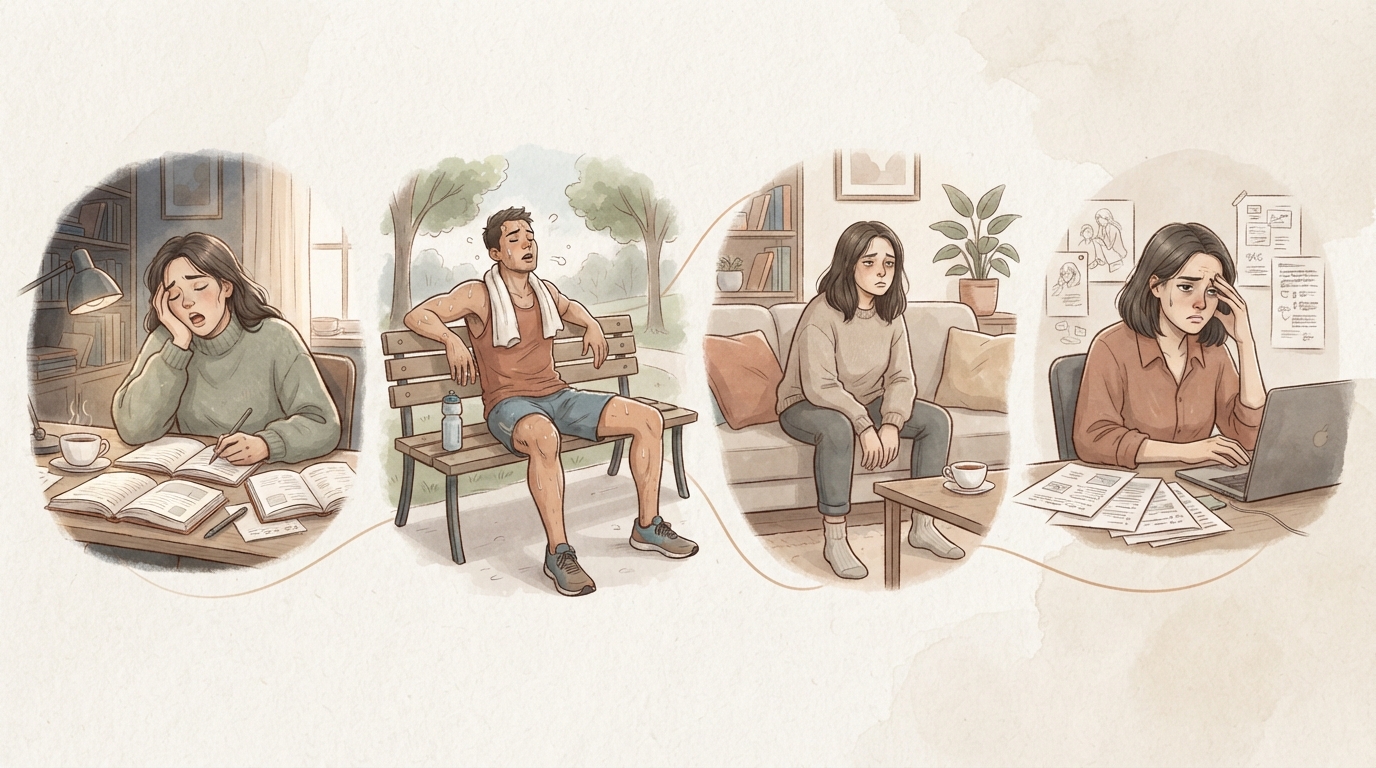
Three Common Ways Energy Patterns Get Misread
Tracking becomes less useful when every pattern immediately turns into an explanation.
“I get tired after lunch, so my blood sugar must be crashing”
Post-meal sleepiness can occur, but the relationship among meals, glucose, and sleepiness is too complex to assume that every afternoon slump reflects a blood sugar problem. Current research still leaves important questions unanswered.
A more useful observation is simply: “I felt sleepy after lunch on several days this week.”
That gives you something concrete to compare without assigning a medical cause.
“Coffee fixes the cause of fatigue”
Caffeine may affect alertness, but that is different from identifying or resolving the reason for persistent fatigue.
If caffeine use repeatedly appears alongside ongoing fatigue or sleep difficulties, include it in your notes and consider the larger pattern rather than assuming more caffeine is the answer.
“My pattern means I have adrenal fatigue”
The term “adrenal fatigue” is often used online to explain nonspecific symptoms such as tiredness and sleep problems. The Endocrine Society states that there is no scientific proof supporting adrenal fatigue as a true medical condition.
Using an unsupported label can distract from other possible explanations for persistent symptoms that deserve appropriate evaluation.
When Low Energy Deserves More Than Tracking
An energy diary can organize useful observations, but it cannot determine why persistent fatigue is happening.
MedlinePlus notes that fatigue has many possible causes and recommends contacting a healthcare provider when tiredness lasts for weeks. Fatigue can also interfere with usual daily activities.
Consider professional guidance when fatigue:
- lasts for several weeks;
- interferes with your usual activities;
- occurs alongside persistent sleep problems;
- is accompanied by excessive daytime drowsiness or difficulty staying awake;
- raises concerns about a medication or another health issue.
If you think a medication may be contributing to fatigue, talk with a qualified healthcare professional before making changes.
Start With One Week, Not a Perfect Routine
The goal is not to build a perfect energy schedule or explain every tired afternoon.
Start with a week of simple, consistent check-ins. Look for repetition before making assumptions. If you notice a reasonable pattern, choose one manageable next step and observe what happens.
If fatigue persists, affects your daily activities, or is difficult to explain, your notes can also give you clearer information to share with a healthcare professional.
Start with one week of simple check-ins. Look for repetition before making assumptions, and use the patterns you notice to choose one manageable next step.
Medical note: This article provides general educational information and is not a substitute for individualized medical advice. Talk with a qualified healthcare professional about fatigue that persists, interferes with your usual activities, or raises concerns about your health or medications.
Sources
- MedlinePlus — Fatigue
Used for fatigue definitions, possible causes, fatigue-diary guidance, and when to seek medical care.
URL: https://medlineplus.gov/fatigue.html - MedlinePlus Medical Encyclopedia — Drowsiness
Used for daytime drowsiness, difficulty staying awake, and the distinction from general fatigue.
URL: https://medlineplus.gov/ency/article/003208.htm - National Institute of General Medical Sciences — Circadian Rhythms
Used for circadian rhythms, biological clocks, and daily changes related to sleep and alertness.
URL: https://www.nigms.nih.gov/education/Pages/Circadian-Rhythms - Centers for Disease Control and Prevention — About Sleep
Used for adult sleep-duration guidance and sleep quality.
URL: https://www.cdc.gov/sleep/about/ - National Heart, Lung, and Blood Institute — Healthy Sleep Habits
Used for regular sleep schedules and caffeine-related sleep guidance.
URL: https://www.nhlbi.nih.gov/health/sleep-deprivation/healthy-sleep-habits - Centers for Disease Control and Prevention — Health Benefits of Physical Activity for Adults
Used for the relationship between regular physical activity and sleep quality.
URL: https://www.cdc.gov/physical-activity-basics/health-benefits/adults.html - MedlinePlus — Dehydration
Used for tiredness and other possible signs of dehydration.
URL: https://medlineplus.gov/dehydration.html - Kaneda H, Kageyama I, Kobayashi Y, Kodama K. — The Influence of Food Intake and Blood Glucose on Postprandial Sleepiness and Work Productivity: A Scoping Review
Used for limitations in the evidence connecting meals, blood glucose fluctuations, and post-meal sleepiness.
URL: https://pubmed.ncbi.nlm.nih.gov/41156470/ - Endocrine Society — Adrenal Fatigue
Used for the scientific limitations of the “adrenal fatigue” concept.
URL: https://www.endocrine.org/patient-engagement/endocrine-library/adrenal-fatigue