
A consistent sleep schedule can provide structure without requiring you to go to bed at the exact same minute every night. A workable routine usually includes a few predictable reference points, enough opportunity for sleep, and a plan for returning after weekends or unexpected changes.
The goal is to create a pattern that fits your responsibilities—not a perfect schedule that makes ordinary life harder.
Medical note: This article provides general educational information and is not a substitute for individualized medical advice. Speak with a qualified healthcare professional if ongoing sleep problems, excessive daytime sleepiness, or other symptoms affect your health, safety, or daily life.
Quick Takeaways
- Consistency is about a recognizable pattern, not exact timing.
- Start with one part of the schedule you can realistically repeat.
- Leave enough time for sleep while planning for weekends and occasional changes.
- After a disruption, return to your usual pattern without changing everything at once.
- Seek professional guidance when sleep problems affect health, safety, or daily life.
What a Consistent Sleep Schedule Really Means
General sleep guidance recommends going to bed and waking up at reasonably regular times. The National Heart, Lung, and Blood Institute, or NHLBI, also recommends keeping weekday and weekend schedules close to one another.
That does not mean monitoring every minute or treating a slightly later night as a failure.
Consistency Is a Pattern, Not a Perfect Number
A consistent sleep schedule is a recognizable pattern. Your bedtime might fall within a practical range rather than at one exact time, and your wake-up time may occasionally shift when responsibilities change.
For example, you might work with a general bedtime range rather than treating one minute as a deadline.
The specific timing will not look the same for everyone. The NHLBI notes that some people naturally wake earlier, while others naturally stay awake later.
Flexibility Still Needs a Reference Point
A flexible sleep schedule is not the same as having no structure. It helps to know what your usual pattern looks like and which part you can protect most often.
Think of your schedule as a familiar route with some room around the edges. The route remains recognizable even when an occasional evening looks different.
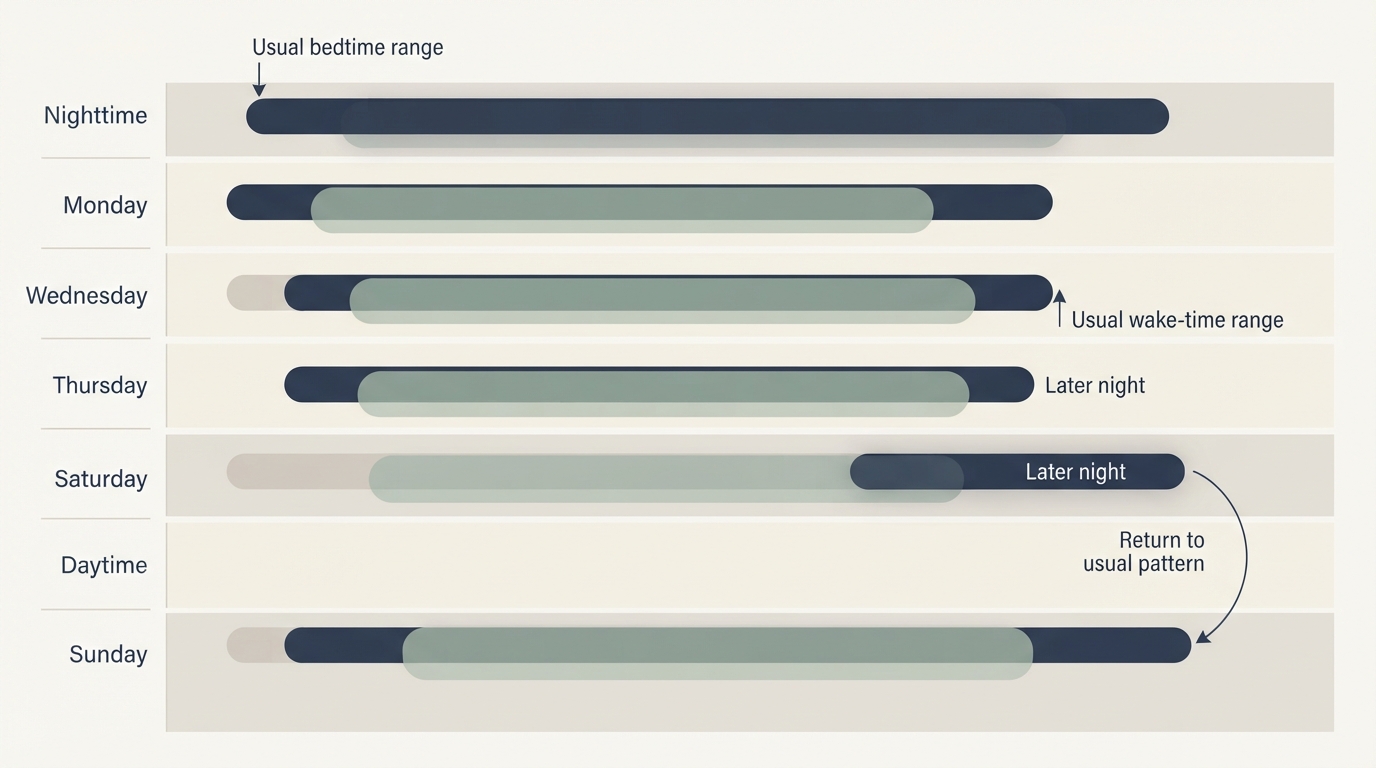
Keep in mind: A regular schedule should still allow enough time for sleep. Consistency does not make up for routinely getting too little rest. The CDC states that adults are generally recommended to get at least seven hours of sleep each day.
Start With the Most Reliable Part of Your Day
Trying to redesign your bedtime, morning routine, meals, exercise, and evening habits all at once can create unnecessary friction.
A simpler approach is to identify one part of the day that is already somewhat predictable.
Consider a Wake-Time Anchor
For some people, wake-up time is a practical anchor because it connects with work, school, caregiving, or morning responsibilities.
A wake-time anchor should not come at the expense of routinely getting too little sleep. The schedule still needs to leave enough opportunity for rest.
Bedtime and wake time both contribute to your sleep-wake pattern. Wake time is simply one possible place to begin, not a universal priority.
Use a Bedtime Range Instead of a Deadline
An exact bedtime may not fit evenings that include family needs, household tasks, a late meal, or an occasional event.
A bedtime range provides structure while allowing ordinary variation. Choose one that works with your morning obligations and leaves enough time for sleep.
Avoid selecting a target based only on what sounds ideal. A workable schedule needs to reflect when you can realistically begin preparing for bed.
Observe Before You Adjust
Before changing the schedule, spend about a week noticing what already happens.
The CDC suggests that a sleep diary may include bedtime, nighttime awakenings, wake time, naps, exercise, caffeine, alcohol, and medications. A basic home check-in can focus on the details most relevant to your routine.
What to Notice for One Week
- Approximate bedtime
- Approximate wake-up time
- Differences between workdays and weekends
- Evening commitments
- Days when waking feels especially difficult
You do not need a sleep tracker or specialized app. A notebook, calendar, or basic phone note may be enough.
Make the Schedule Easier to Repeat
A useful plan needs to work on busy days, not only when the evening goes exactly as expected.
Change One Part of the Routine First
Look at the pattern you observed and identify the largest source of variation.
Perhaps wake-up time shifts substantially on weekends. Maybe bedtime changes because evening tasks have no clear stopping point. Choose one issue instead of rebuilding the whole routine.
A smaller adjustment may be more realistic to repeat. You could narrow your usual wake-up range, begin winding down somewhat earlier, or reduce a large difference between workdays and weekends.
READ MORE:
Build Around Real Commitments
Your schedule needs to account for:
- work hours and commuting;
- children or caregiving;
- evening meals;
- household responsibilities;
- exercise;
- social or community plans.
Decide which obligations are fixed and where you have room to make a manageable change. A plan that ignores your responsibilities is unlikely to remain practical.
Use Simple Cues
Environmental cues can help mark the transition between an active evening and your usual sleep period.
You might dim unnecessary lights, finish stimulating tasks, prepare a few things for the morning, or begin one brief calming activity. Light and darkness are among the signals that help coordinate the sleep-wake cycle.
Keep the cue simple. An elaborate routine is not required.
A Manageable First-Step Plan
- Notice the largest source of variation.
- Choose one workable anchor.
- Make a small adjustment.
- Repeat it on most days.
- Review what gets in the way.
- Modify the plan without abandoning it.
Keep Weekends From Becoming a Complete Reset
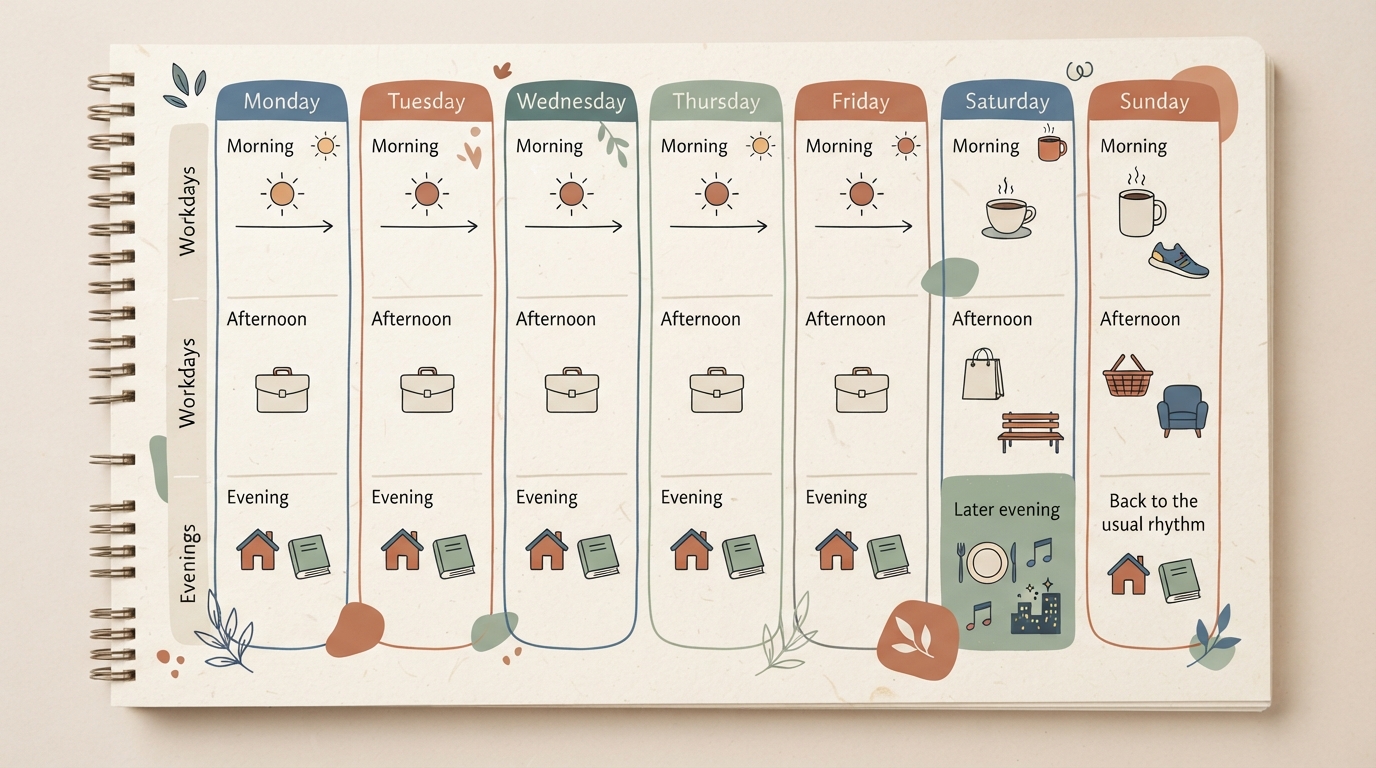
A sleep schedule on weekends does not need to match every weekday minute. However, large shifts may make the return to the workweek more difficult.
Plan for Some Variation
The NHLBI recommends limiting the difference between weekday and weekend sleep schedules to no more than about one hour. It notes that staying up and sleeping much later on weekends can disrupt the sleep-wake rhythm. Treat this as general guidance rather than a pass-or-fail test, especially when work, caregiving, travel, illness, or special events affect your timing.
The broader aim is to avoid making every weekend an entirely separate schedule.

Make Exceptions Deliberate
An occasional late event does not need to turn into several days of unplanned changes.
It may help to decide which plans are worth an exception and which part of your regular schedule you will return to afterward. This leaves room for social life without losing sight of the broader pattern.
Do Not Ignore the Need for Rest
Regularity is only one part of healthy sleep. It should not be used as a reason to ignore significant sleep loss.
Frequently needing much more sleep on weekends may suggest that the weekday schedule is not leaving enough opportunity for sleep. Some additional rest may be reasonable after insufficient sleep, but the longer-term goal is to make enough sleep possible more consistently rather than relying on major weekend changes.
Common Schedule Challenges and Flexible Responses
| Common challenge | A practical response | What to avoid |
|---|---|---|
| Weekend plans run late | Return to the usual pattern when practical | Treating the entire weekend as lost |
| Bedtime changes from day to day | Use a reasonable bedtime range | Expecting precision to the minute |
| Work or family duties shift | Protect the most controllable anchor | Changing every part of the routine |
| One night is unusually short | Allow adequate rest, then return to the usual pattern when practical | Trying to correct every part of the schedule at once |
How to Get Back on a Sleep Schedule After a Late Night
One late night does not require a complete reset. Return to the most manageable parts of your usual pattern without trying to correct everything immediately.
Start here: After an unusual night, return to the most practical part of your usual schedule rather than rebuilding the entire routine.
Return to Your Usual Anchor
Use your normal bedtime or wake-time range as a reference at the next practical opportunity.
The goal is to prevent one change from becoming several days of unpredictable timing.
Avoid Overcorrecting
Avoid making several extreme adjustments at once. A highly restrictive response may be difficult to maintain and may ignore how sleepy you feel.
Do not drive or perform safety-sensitive work when you are struggling to stay alert. NIOSH advises fatigued drivers to pull over rather than continue driving.
Use the Next Day as a Return Point
Treat the following day as an opportunity to move back toward your usual pattern, not as a test you must pass.
Keep one or two familiar reference points, allow adequate opportunity for sleep, and resume your usual evening cues. How quickly the schedule settles can vary with travel, work demands, health, age, and the size of the timing change.
A Realistic Sleep Schedule Check-In
- I know which part of my schedule changes the most.
- I am allowing enough time for sleep.
- I have chosen one workable anchor.
- My target uses a reasonable range rather than an exact minute.
- I have considered weekends and social plans.
- I know how I will return after an unusual night.
- I know when ongoing sleep problems may need professional guidance.
When a Flexible Schedule May Not Be Enough
Speak with a qualified healthcare professional if trouble falling or staying asleep persists, daytime sleepiness interferes with normal activities, or sleep difficulties affect safety. The CDC recommends speaking with a healthcare provider when you have problems sleeping.
Frequent loud snoring, gasping, observed pauses in breathing, or persistent daytime sleepiness can also be reasons to request an evaluation. These signs can occur with sleep-related breathing disorders, but they should not be used for self-diagnosis.
People who work night or rotating shifts may need a different strategy because nonstandard schedules can reduce sleep opportunities and contribute to fatigue.
When to get help: Speak with a qualified healthcare professional if sleep problems persist, daytime sleepiness affects driving or work, or symptoms such as loud snoring or observed breathing pauses interfere with daily life.
Frequently Asked Questions
Does a sleep schedule have to be exact?
No. A consistent sleep schedule can use practical ranges instead of exact minutes. The aim is to maintain a recognizable pattern while leaving enough opportunity for sleep.
Is it okay to sleep later on weekends?
Some variation is normal. The NHLBI recommends limiting the difference between weekday and weekend schedules to about one hour, although individual circumstances can make that difficult on some days.
When should I get professional help with my sleep schedule?
Consider seeking guidance when sleep problems persist, interfere with daily life, affect driving or work safety, or occur with symptoms such as gasping, loud snoring, or observed breathing pauses.
A Consistent Schedule Should Support Your Life
A practical sleep schedule is built by choosing a few useful reference points, allowing enough time for sleep, and returning to the broader pattern after ordinary disruptions.
Start with the part of your routine that feels easiest to repeat. A small, workable change is more useful than a demanding schedule you cannot maintain.
Choose one manageable part of your sleep schedule to make more predictable this week. Then explore our related sleep and relaxation guides for your next small step.
Sources
- National Heart, Lung, and Blood Institute — Healthy Sleep Habits
Used for: regular sleep and wake times and the approximately one-hour difference between weekday and weekend schedules.
URL:https://www.nhlbi.nih.gov/health/sleep-deprivation/healthy-sleep-habits - National Heart, Lung, and Blood Institute — Your Sleep/Wake Cycle
Used for: individual differences in natural sleep timing and environmental cues affecting the sleep-wake cycle.
URL:https://www.nhlbi.nih.gov/health/sleep/sleep-wake-cycle - Centers for Disease Control and Prevention — About Sleep
Used for: sleep diaries and guidance to speak with a healthcare provider about sleep problems.
URL:https://www.cdc.gov/sleep/about/index.html - Centers for Disease Control and Prevention — FastStats: Sleep in Adults
Used for: the general recommendation that adults get at least seven hours of sleep each day.
URL:https://www.cdc.gov/sleep/data-research/facts-stats/adults-sleep-facts-and-stats.html - Centers for Disease Control and Prevention, NIOSH — Driver Fatigue on the Job
Used for: safety guidance related to driving while fatigued.
URL:https://www.cdc.gov/niosh/motor-vehicle/driver-fatigue/index.html - National Heart, Lung, and Blood Institute — Sleep Apnea Symptoms
Used for: loud snoring, gasping, breathing pauses, and daytime symptoms that may justify professional evaluation.
URL:https://www.nhlbi.nih.gov/health/sleep-apnea/symptoms - Centers for Disease Control and Prevention, NIOSH — Shiftwork, Long Work Hours, Fatigue
Used for: why people with nonstandard work schedules may need a different sleep strategy.
URL:https://www.cdc.gov/niosh/learning/safetyculturehc/module-2/9.html - Centers for Disease Control and Prevention, NIOSH — Coping With Night and Evening Shifts
Used for: reduced sleep opportunities associated with night work.
URL:https://www.cdc.gov/niosh/work-hour-training-for-nurses/longhours/mod9/06.html