
A useful morning routine does not need to begin at 5 a.m. or include a long list of habits. The goal is to create a simple sequence that helps you move from waking up to starting your day with less friction.
This guide explains how to build a realistic morning routine around a few flexible elements, including light, hydration, movement, food, and basic planning. You will also find 5-, 15-, and 30-minute options for days with different schedules.
A routine can create structure, but it cannot replace adequate sleep or explain every cause of low energy.
Quick Takeaways
- A realistic morning routine should fit your actual schedule.
- Begin with two or three steps before adding more.
- Light, hydration, movement, and food may play different roles for different people.
- A 5-minute version still counts on busy days.
- A morning routine cannot compensate for consistently inadequate sleep or explain persistent fatigue.
What Makes a Morning Routine Realistic?
A realistic routine is not the one with the most habits. It is the one you can still use on an ordinary Tuesday when you are short on time or the morning does not go as planned.
It Fits the Time You Actually Have
Start with your real schedule rather than an ideal version of it.
A parent preparing children for school, a person commuting to work, and someone beginning an evening shift will not need identical routines. Your sequence should fit around your responsibilities instead of competing with them.
It Has a Minimum Version
Create a version you can complete in about five minutes. It might include opening the curtains, drinking water, and identifying your first necessary task.
That short sequence gives your morning a recognizable starting point when a longer version is not practical.
It Can Change Without Disappearing
Consistency does not require every morning to look exactly the same. You might use the full routine on a quiet day and a shorter version when you are rushed.
Start here: Choose two steps that make the transition from sleep to your day easier. Add another habit only after the first version feels manageable.

The Core Building Blocks of a Morning Routine
The following elements are options, not a mandatory checklist. Choose the ones that fit your schedule, preferences, and health circumstances.
Start With a Predictable Wake-Up Sequence
A reasonably consistent sleep and wake schedule is commonly included in healthy sleep guidance. The National Heart, Lung, and Blood Institute recommends going to bed and waking up at similar times each day and limiting large differences between weekday and weekend schedules.
You do not need to follow the clock perfectly. A familiar order—such as getting up, opening the curtains, washing up, and getting dressed—may be easier to repeat than a complicated plan.
Get Some Morning Light
Light and darkness are among the environmental cues involved in regulating the body’s internal sleep-wake cycle.
Opening the curtains or moving into a brighter space can be a simple part of your wake-up routine. Spending a little time outside may also be an option when the weather, environment, and your circumstances make it appropriate.
This is general routine guidance, not light therapy advice. Individual needs and health considerations vary.
Rehydrate in a Simple Way
Drinking water can be a simple way to begin meeting your fluid needs for the day. The CDC notes that drinking enough water helps prevent dehydration and that individual needs vary.
There is no universal amount that everyone needs to drink immediately after waking. Climate, activity level, pregnancy, breastfeeding, and health circumstances may affect fluid needs.
Feeling tired can occur with dehydration, but fatigue has many possible causes. It should not automatically be interpreted as a sign that you simply need more water.
Add a Small Amount of Movement
Morning movement does not need to be a full workout. Gentle mobility, walking around the home, or taking a short walk can be a practical transition from rest into the activities of the day.
Physical activity has established immediate and long-term health benefits, but a few minutes of morning movement should not be presented as a guaranteed energy boost.
Choose movement that feels appropriate for your abilities and health circumstances. Speak with a qualified healthcare professional when you need individualized guidance.
Choose Food Based on Your Needs
Some people are ready to eat soon after waking, while others prefer to wait. Appetite, timing, culture, and individual needs vary.
When you eat in the morning, choose something practical that fits your appetite and broader nutritional needs. Breakfast does not need to follow one fixed formula or include complicated recipes.
Choose One Clear Next Step
Before messages or a long task list take over, identify the first necessary step.
That might mean getting ready for work, preparing a child’s breakfast, packing a bag, or beginning one essential task. The goal is to reduce friction, not maximize every minute.
Build a 5-, 15-, or 30-Minute Morning Routine
Your routine can have several versions. More time gives you more options, but it does not automatically create a better morning.
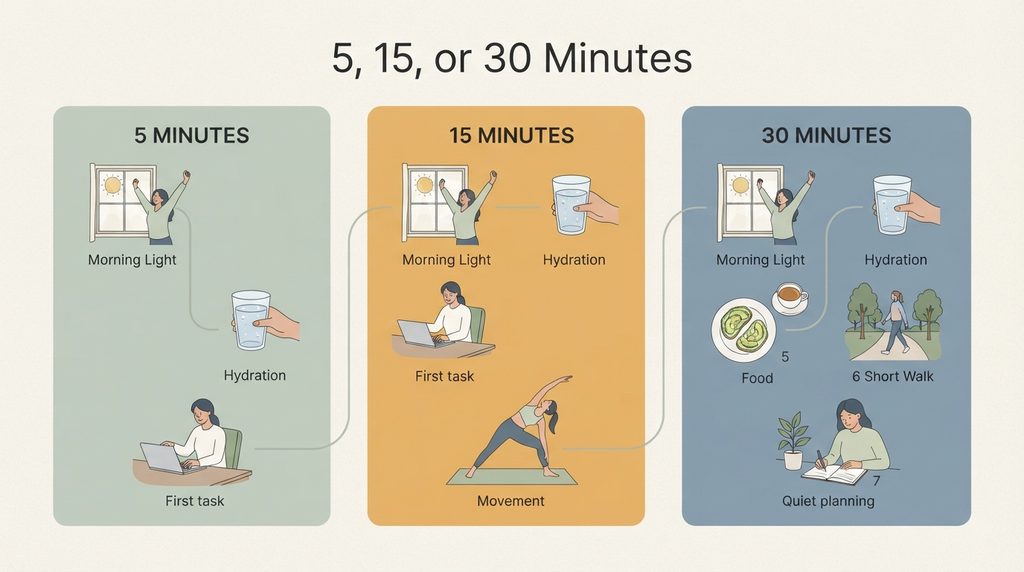
A 5-Minute Minimum Routine
Use this version when you are rushed:
- Open the curtains or move into a brighter space.
- Drink water or another suitable beverage.
- Complete one basic transition step, such as washing up or getting dressed.
- Identify the first necessary task.
A 15-Minute Everyday Routine
When you have a little more time:
- Get some light.
- Have a drink.
- Add a few minutes of gentle movement.
- Prepare food or eat if that fits your needs.
- Review your first priority.
A 30-Minute Expanded Routine
On less rushed days:
- Begin with light and hydration.
- Add gentle movement or a short walk.
- Eat if you are hungry.
- Prepare for the first part of the day.
- Include an optional activity, such as quiet planning or a few minutes outdoors.
The extra activity should support your morning rather than make it feel crowded.
Morning Routine Options by Available Time
| Available time | Core steps | Optional addition | May fit |
|---|---|---|---|
| 5 minutes | Light, hydration, and one clear next step | None | Rushed mornings |
| 15 minutes | Light, hydration, and brief movement | Food or simple planning | Typical weekdays |
| 30 minutes | Light, hydration, movement, and food if desired | A short walk or quiet planning | Less rushed days |
How to Make the Routine Easier to Repeat
A sustainable morning routine should remove unnecessary effort rather than create another demanding project.
READ MORE:
Prepare One or Two Things the Night Before
Focus on the part of the morning that usually creates the most friction:
- Set out clothing.
- Prepare a simple breakfast item.
- Place a glass or suitable drink container where it is easy to reach.
- Decide which task needs to come first.

Use the Same Order More Often Than the Same Clock Time
An exact schedule may not be realistic for parents, caregivers, shift workers, or people with changing obligations.
Instead, keep the general order familiar: light, drink, get ready, move if appropriate, and then begin the first task. The sequence can remain recognizable even when the clock time changes.
Add One Habit at a Time
Adding hydration, exercise, meditation, journaling, meal preparation, and detailed planning all at once can turn a simple routine into another source of pressure.
Begin with the smallest workable version. Add something new only when the existing sequence feels manageable.
Keep What Is Actually Useful
As you use the routine, notice which steps make mornings easier and which ones create unnecessary pressure.
Keep what is practical. Shorten, move, or remove the rest.
Adapt the Routine to Your Life
- Busy workdays: Use the minimum version and prepare one item the night before. A five-minute routine may be more useful than a long plan you rarely complete.
- Parents and caregivers: Expect interruptions. Choose steps that can happen alongside caregiving responsibilities rather than requiring uninterrupted quiet time.
- Shift workers: Your “morning” is the period after you wake up, even when that happens in the afternoon or evening. Build the sequence around your actual work schedule.
- Weekends and changing schedules: The routine does not need to match your weekday version. Keeping one or two familiar steps may provide continuity without making the day rigid.
Common Morning Routine Mistakes
Adding too many habits at once. A crowded routine is more difficult to repeat and may create unnecessary pressure.
Copying someone else’s schedule. A routine designed around another person’s job, family, or lifestyle may not fit yours.
Treating the longest routine as the best routine. More activities do not guarantee a better morning.
Depending entirely on motivation. Reduce steps and prepare in advance so the routine requires fewer decisions.
Using caffeine as the entire strategy. Caffeine may be part of a morning routine, but it cannot compensate for consistently inadequate sleep or explain persistent fatigue.
Expecting the morning to replace sleep. Adequate sleep remains a separate foundation of healthy brain function and physical health.
Giving up after one disrupted day. Return to the shortest version instead of waiting for a perfect morning.
When Low Energy May Need More Attention
A morning routine can support structure, but it cannot explain every cause of low energy.
MedlinePlus advises contacting a healthcare provider when fatigue does not improve after several weeks. Fatigue that persists or interferes with daily activities may deserve individualized attention.
Avoid trying to identify the cause through a general wellness article. Sleep difficulties, health conditions, medications, and other factors may contribute to how a person feels.
When to get help: Consider speaking with a qualified healthcare professional when fatigue persists, worsens, or interferes with daily life.
Your Morning Routine Checklist
- Choose a version that fits today.
- Begin with two or three basic steps.
- Prepare one item the night before.
- Add new habits gradually.
- Keep what feels practical.
Persistent or unexplained fatigue deserves separate attention rather than another routine adjustment.
A Manageable Start Matters More Than a Perfect One
Start with the shortest version that feels realistic. Once the sequence becomes familiar, add another step only when it genuinely supports your morning.
The goal is a manageable transition into the day, not an impressive list of habits.
Choose the shortest version that fits your next morning. For a broader overview, explore our guide to everyday habits that may support steadier energy.
Medical note: This article provides general educational information and is not a substitute for individualized medical advice. Speak with a qualified healthcare professional about persistent, unexplained, or worsening fatigue or other concerns about your energy levels.
Sources
- National Heart, Lung, and Blood Institute — Sleep Deprivation and Deficiency: Healthy Sleep Habits
Used for: guidance on maintaining reasonably consistent sleep and wake schedules.
URL:https://www.nhlbi.nih.gov/health/sleep-deprivation/healthy-sleep-habits - National Heart, Lung, and Blood Institute — How Sleep Works: Your Sleep/Wake Cycle
Used for: the role of the internal circadian clock and light in the sleep-wake cycle.
URL:https://www.nhlbi.nih.gov/health/sleep/sleep-wake-cycle - National Heart, Lung, and Blood Institute — Circadian Rhythm Disorders
Used for: environmental cues involved in aligning the sleep-wake cycle.
URL:https://www.nhlbi.nih.gov/health/circadian-rhythm-disorders - National Heart, Lung, and Blood Institute — Why Is Sleep Important?
Used for: the importance of sleep for healthy brain function and physical health.
URL:https://www.nhlbi.nih.gov/health/sleep/why-sleep-important - Centers for Disease Control and Prevention — About Water and Healthier Drinks
Used for: the role of water in helping prevent dehydration and factors that affect fluid needs.
URL:https://www.cdc.gov/healthy-weight-growth/water-healthy-drinks/index.html - MedlinePlus — Dehydration
Used for: tiredness as one possible symptom of dehydration.
URL:https://medlineplus.gov/dehydration.html - Centers for Disease Control and Prevention — Benefits of Physical Activity
Used for: established immediate and long-term benefits of physical activity.
URL:https://www.cdc.gov/physical-activity-basics/benefits/index.html - MedlinePlus — Fatigue
Used for: guidance on contacting a healthcare provider when fatigue does not improve after several weeks.
URL:https://medlineplus.gov/fatigue.html - MedlinePlus Medical Encyclopedia — Fatigue
Used for: guidance on seeking evaluation when fatigue is not relieved by adequate sleep, nutrition, or lower stress.
URL:https://medlineplus.gov/ency/article/003088.htm