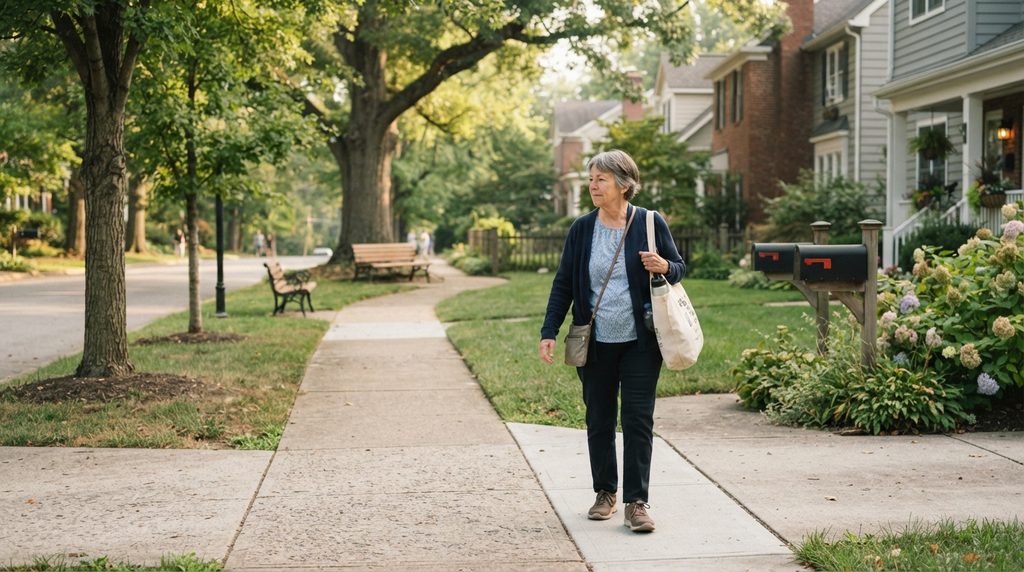
Muscle strength shows up in ordinary moments. You use it when you get out of a chair, carry groceries, open a heavy door, or climb a flight of stairs.
It is not only about lifting heavy weights, building visible muscle, or performing well in a gym. Strength is the ability your muscles use to produce force, and it supports many of the movements involved in everyday life.
Strength and physical performance can change with age, but age alone does not explain a person’s abilities. Activity level, periods of inactivity, health conditions, and other individual circumstances can also influence physical function.
Understanding why muscle strength matters as we age can make physical activity feel more relevant and less intimidating. It can also clarify how strength fits alongside walking, mobility, balance, and endurance in a broader healthy-aging routine.
Quick Takeaways
- Muscle strength supports many everyday movements, not just exercise or sports.
- Strength, mobility, balance, and endurance are related but different.
- Changes in strength can occur with age, but individual patterns vary.
- Muscle-strengthening activity can be adapted to different abilities and settings.
- Pain, dizziness, balance concerns, or health conditions may be reasons to seek professional guidance.
What Muscle Strength Means in Everyday Life
Muscle strength is the ability to produce force against some form of resistance. That resistance might come from your body weight, an object you are carrying, an elastic band, a hand-held weight, or a machine.
You do not need to consider yourself athletic to use strength. It is already part of many common activities, including:
- Standing up from a chair
- Carrying groceries or laundry
- Climbing steps
- Pushing or pulling a door
- Lifting household items
- Moving an object from one place to another

Strength is also different from muscle size. Muscle mass, measured strength, and physical performance are related, but they are not interchangeable.
A systematic review and meta-analysis involving older populations found that lower measures of muscle strength and physical performance were associated with a greater likelihood of future difficulty with activities of daily living. This does not mean strength alone determines independence, but it helps explain why strength is a meaningful part of physical function.
Why Strength Can Become More Important With Age
Muscles Respond to Both Aging and Activity
Strength and physical performance may change over time, but people of the same age can have very different abilities, activity histories, and health circumstances.
Muscles can also respond to resistance exercise. Research reviews have found that resistance training can improve strength and aspects of physical function in older adults, although the size of the response varies among people and programs.
Resistance training is a form of muscle-strengthening activity in which the muscles work against body weight or another form of resistance. It does not automatically mean heavy lifting or an intense gym routine.
The National Institute on Aging lists body-weight movements, resistance bands, hand-held weights, and machines among the ways muscles can work against resistance.
Strength Supports Daily Function
Strength rarely works alone. Climbing a step, for example, may involve strength, balance, coordination, and mobility rather than strength alone.
Pain, joint limitations, endurance, vision, medical conditions, and the surrounding environment can also affect how easy or difficult a task feels. Strength cannot guarantee that every daily activity will remain easy, but it supports many of the physical actions involved in everyday living.
Strength Is Not the Same as Mobility, Balance, or Endurance
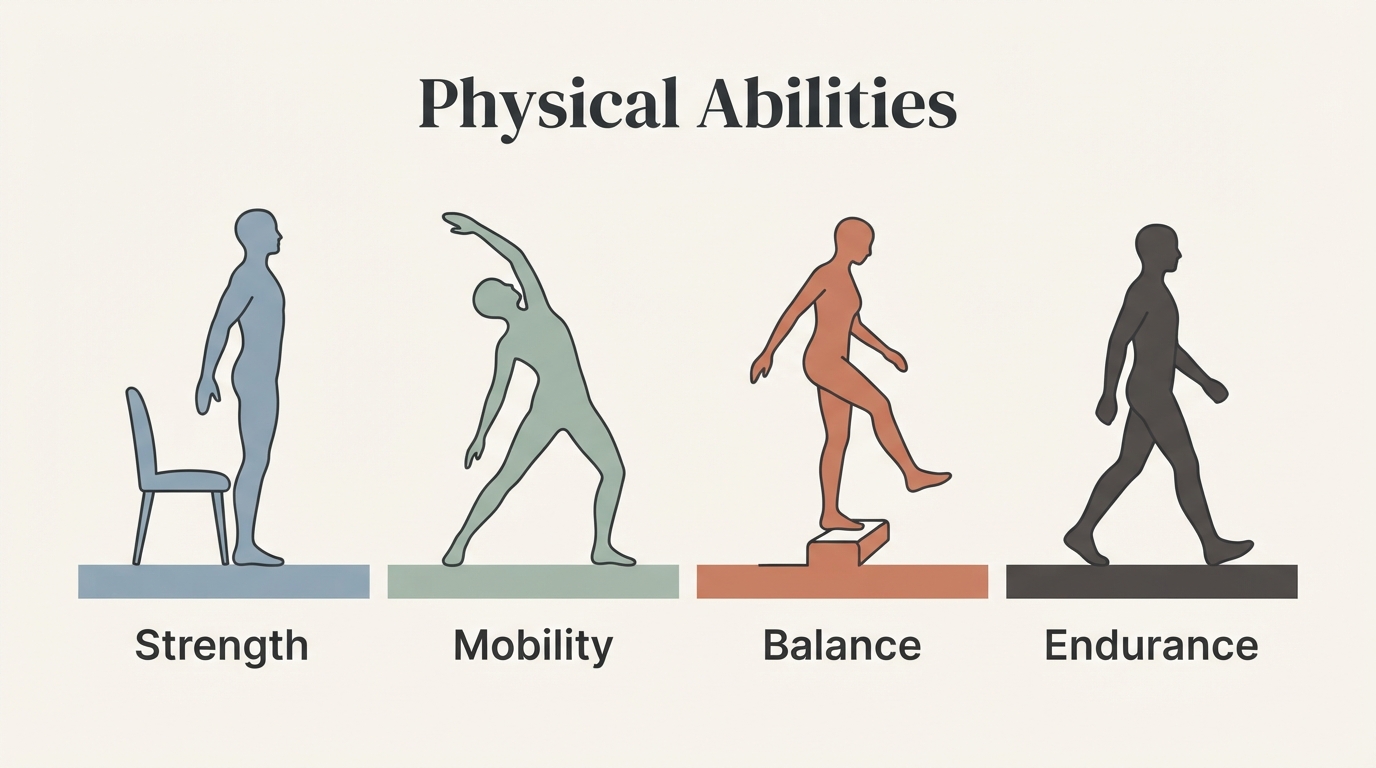
These abilities work together, but they describe different parts of physical function.
| Factor | Simple meaning | Everyday example |
|---|---|---|
| Muscle strength | The ability to produce force against resistance | Standing up from a chair |
| Mobility | The ability to move through a useful range | Reaching or turning |
| Balance | The ability to stay steady | Stepping over a curb |
| Endurance | The ability to continue an activity over time | Walking for several minutes |
Current U.S. physical activity guidance treats aerobic, muscle-strengthening, and balance activities as distinct parts of a well-rounded routine for adults ages 65 and older. The CDC recommends muscle-strengthening activities on at least two days each week, along with aerobic and balance activities. These are general public health recommendations, not an individualized exercise plan.
Keep in mind: Walking, strength, balance, and mobility can support different parts of everyday movement. One activity does not have to do everything, and the right mix depends on your abilities, health, and preferences.
Ways to Include Muscle-Strengthening Activity
Muscle-strengthening activities can take several forms. The most appropriate choice depends on your current ability, experience, setting, health, and personal preferences.
Using Your Own Body Weight
Your body can provide resistance during movements such as rising from a chair, pushing against a wall, or performing another appropriately adapted body-weight movement.
A movement is not automatically appropriate for everyone simply because it uses no equipment. Seat height, balance, joint comfort, technique, and the availability of stable support can all affect how manageable it feels.
READ MORE:
Using Bands, Weights, or Machines
Resistance may also come from:
- Elastic resistance bands
- Hand-held weights
- Weight machines
- Appropriately handled household objects
The National Institute on Aging includes bands, machines, hand-held weights, body-weight movements, carrying objects, and some gardening activities among examples that may challenge the muscles.
Equipment is not necessary for everyone. The amount and type of resistance should match the person’s experience, abilities, and capacity to perform the movement with control.
Everyday Tasks Can Use Strength
Carrying groceries, digging in a garden, or moving household objects may challenge the muscles. However, daily tasks do not necessarily provide balanced or gradually progressive resistance for all major muscle groups.
Rather than deciding whether an activity “counts” perfectly, consider what it asks your body to do, how often you do it, and whether it fits your current abilities.
A Realistic Starting Point
A starting point does not need to be intense. It should reflect what you can currently do with reasonable control and stability.
These are general planning considerations, not an individualized exercise program.
A Realistic Starting-Point Checklist
- Consider your current activity level.
- Choose a stable, manageable form of resistance.
- Focus on controlled movement.
- Make changes gradually rather than increasing several demands at once.
- Include more than one type of physical activity.
- Pay attention to pain, dizziness, or balance problems.
- Seek guidance when you need help adapting an activity.
Walking and Strength Play Different Roles
Walking is a valuable and accessible aerobic activity for many people. It can support endurance and regular movement, but it does not necessarily place the same demands on the muscles as targeted resistance activity.
That does not make one activity better than the other. Current guidance includes aerobic, muscle-strengthening, and balance activities because they serve different purposes and can complement one another.
When Professional Guidance May Be Helpful
Individual guidance may be helpful when symptoms, health conditions, recent injuries, or physical limitations make it difficult to choose or adapt an activity.
Consider speaking with a qualified healthcare professional if you have:
- Pain during movement
- A recent injury or surgery
- Dizziness or recurring unsteadiness
- Balance concerns
- A history of falls
- A new or noticeable change in strength
- A health condition that affects physical activity
- Difficulty performing usual daily tasks
- Questions about how to adapt an activity
Balance problems and dizziness can have several possible causes. Recurring symptoms should be discussed with a healthcare professional rather than self-diagnosed from an exercise article.
Medical note: This article provides general educational information and is not a substitute for individualized medical advice. Speak with a qualified healthcare professional if you have pain, balance concerns, a recent injury, a medical condition, or questions about adapting physical activity to your needs.
Common Questions About Muscle Strength and Aging
Can Older Adults Improve Muscle Strength?
Research suggests that many older adults can improve strength through appropriately designed resistance training. Results vary, however, and no specific amount of improvement can be guaranteed for an individual.
The activity should be matched to the person’s experience, abilities, and health circumstances.
Is Walking Enough for Muscle Strength?
Walking is primarily an aerobic activity, even though the leg muscles are involved. Current physical activity guidance recommends walking or another form of aerobic movement alongside separate muscle-strengthening and balance activities.
A routine does not need to be complicated, but walking should not automatically be treated as a complete substitute for every other type of activity.
Do You Need Weights to Build Strength?
Not necessarily. Muscle-strengthening activity can use body weight, resistance bands, hand-held weights, machines, or other appropriately adapted forms of resistance.
Weights are one option rather than a requirement.
The Bottom Line
Muscle strength matters as you age because it supports familiar movements, from standing and carrying to climbing steps and handling household tasks.
It is not the same as mobility, balance, or endurance, and it does not require an extreme workout or a particular piece of equipment. Strength-building activity can take several forms and should be adapted to the individual.
A manageable first step is often more useful than a routine that feels intimidating or unsustainable. Consider your current abilities, make changes gradually, and seek guidance when symptoms, health conditions, or uncertainty make adaptation difficult.
Muscle strength is one part of a broader healthy-aging routine. Choose one manageable step and explore our related guides to walking, mobility, and recovery when you are ready to continue.
Sources
- Centers for Disease Control and Prevention — Older Adult Activity: An Overview
Used for: Current U.S. recommendations for aerobic, muscle-strengthening, and balance activities among adults ages 65 and older.
URL:https://www.cdc.gov/physical-activity-basics/guidelines/older-adults.html - Centers for Disease Control and Prevention — What Counts as Physical Activity for Older Adults
Used for: The role of walking as aerobic activity and the broader weekly activity recommendations.
URL:https://www.cdc.gov/physical-activity-basics/adding-older-adults/what-counts.html - National Institute on Aging — Three Types of Exercise Can Improve Your Health and Physical Ability
Used for: Examples of muscle-strengthening activities and different forms of resistance.
URL:https://www.nia.nih.gov/health/exercise-and-physical-activity/three-types-exercise-can-improve-your-health-and-physical - Wang DXM et al. — Muscle Mass, Strength, and Physical Performance Predicting Activities of Daily Living: A Meta-Analysis
Used for: Associations between muscle measures, physical performance, and future difficulty with daily activities.
URL:https://pubmed.ncbi.nlm.nih.gov/31788969/ - Radaelli R et al. — Effects of Resistance Training Volume on Physical Function, Lean Body Mass, Lower-Body Muscle Hypertrophy, and Strength in Older Adults
Used for: Evidence that resistance training can improve strength and physical function in healthy older adults.
URL:https://pubmed.ncbi.nlm.nih.gov/39405023/ - Kashi SK et al. — A Systematic Review and Meta-Analysis of Resistance Training in Older Adults
Used for: Evidence related to muscle strength and functional exercise capacity.
URL:https://pubmed.ncbi.nlm.nih.gov/35968662/ - U.S. Department of Health and Human Services — Physical Activity Guidelines for Americans, Second Edition
Used for: Recommendations to include muscle-strengthening activities involving the major muscle groups on at least two days each week.
URL:https://www.cdc.gov/physical-activity/media/pdfs/Physical_Activity_Guidelines_2nd_edition.pdf