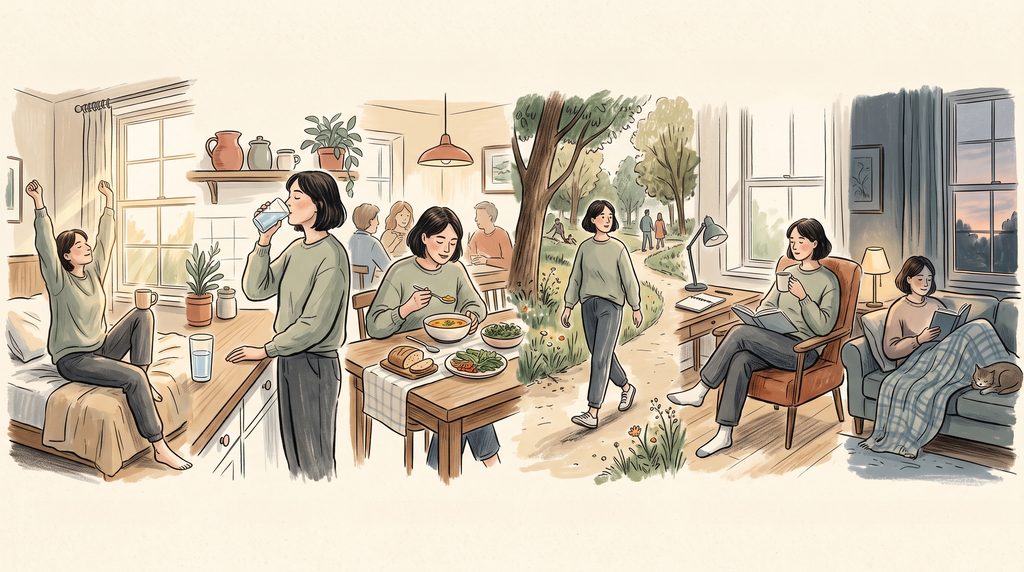
Energy tracking can help you notice how your energy changes throughout the day instead of relying on memory. Some mornings, you feel ready for the day. By midafternoon, ordinary tasks may seem more demanding. On other days, your energy feels relatively steady, or you notice a completely different pattern.
By recording how energetic you feel at a few points throughout the day, you may begin noticing patterns related to sleep, activities, rest, and everyday routines.
This guide gives you a simple checklist, a completed example, and practical questions for reviewing your observations. You can get started with a notebook or notes app—no special equipment required.
Quick Takeaways
- Rate your perceived energy at a few convenient times each day.
- Add brief notes about sleep, activities, rest, or other relevant circumstances.
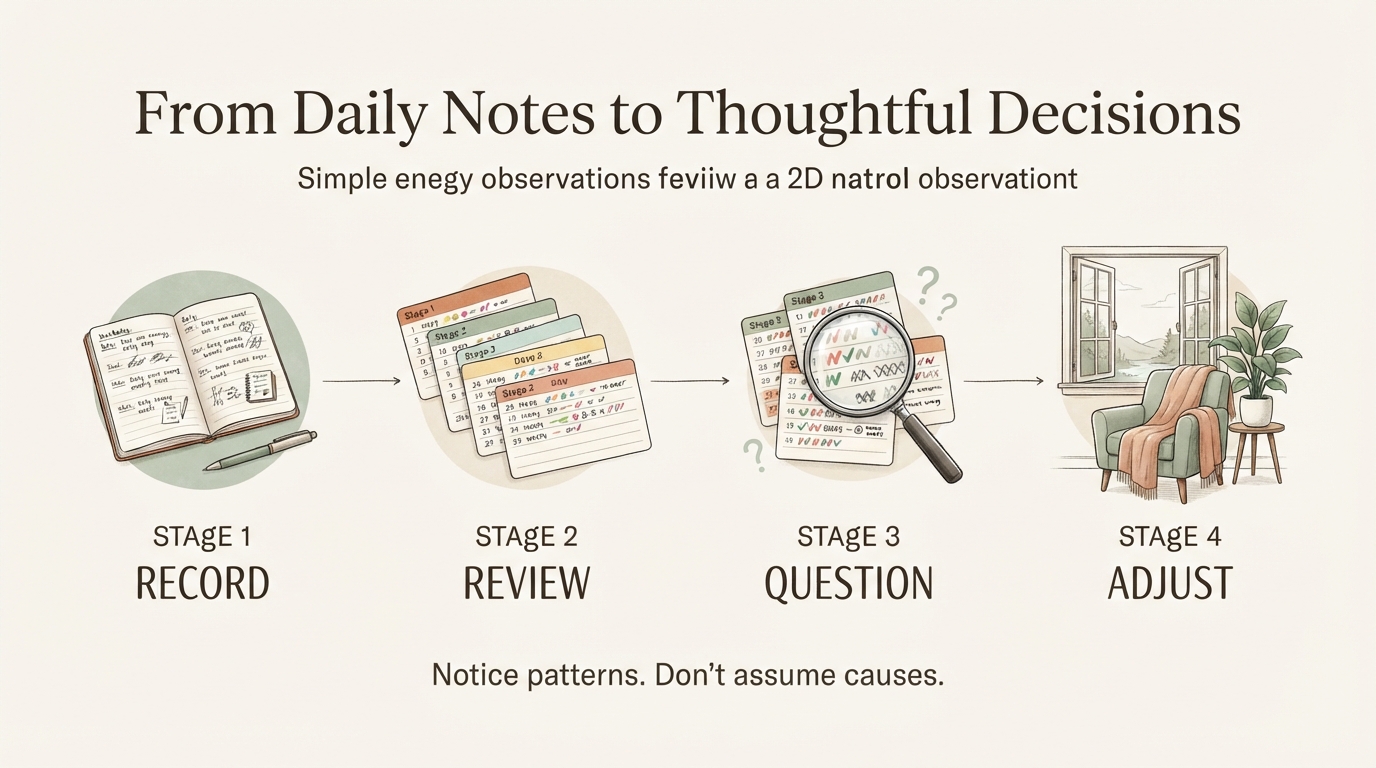
- Use energy tracking to look for recurring patterns without assuming you have identified their causes.
- Seek medical advice if fatigue is persistent, unexplained, or interfering with daily life.
The Simple Energy Tracking Checklist
You do not need to document everything you do to understand your daily energy levels.
Start by noticing how much physical or mental energy you feel you have at a particular moment. Then add a little context about your day.
The National Library of Medicine’s MedlinePlus guidance on fatigue suggests keeping a diary to help identify periods when you feel more or less tired.
The British Heart Foundation also provides a personal fatigue diary that connects symptoms with daily activities. That resource is designed for people living with heart conditions. The simplified checklist below is a separate, general-purpose approach to personal observation, not a clinical assessment.
Rate Your Energy From 1 to 5
Begin energy tracking by giving your current energy a rating based on how you usually feel.
| Rating | How Your Energy Might Feel |
|---|---|
| 1 — Very low | Much less energy than usual; everyday activities feel especially demanding. |
| 2 — Low | Less energy than usual; you feel somewhat drained. |
| 3 — Moderate | Around your usual energy level; you can manage familiar activities comfortably. |
| 4 — High | More energy than usual; you feel fairly alert and ready for activities. |
| 5 — Very high | Much more energy than usual; you feel particularly energetic. |
These descriptions are flexible reference points, not medical categories. The scale is an informal tool for rating perceived energy, not a clinically validated measure of health or performance.
Use the same general interpretation each time so your entries are easier to compare.
Note the Time and a Few Context Clues
Energy tracking becomes more informative when you include one or two details about what was happening.
Consider noting:
- Sleep: How long you slept and whether you woke feeling rested.
- Activities: Work, exercise, household tasks, or extended sitting.
- Meals and drinks: Meal timing, caffeine, or unusual changes in your routine.
- Rest: Breaks, naps, or opportunities to recover.
- Stress: Particularly demanding or emotionally difficult periods.
You do not need to track every category.
Sleep is one useful factor to observe. The Centers for Disease Control and Prevention (CDC) explains that sleep quality matters alongside duration, and feeling tired despite spending enough time in bed may indicate poor sleep quality.
Still, one restless night does not necessarily explain every change in energy.
Copy-and-Use Daily Checklist
Copy this energy tracking checklist into a notebook, spreadsheet, or notes app.
Date: __________
Last night’s sleep: __________
How rested did I feel when I woke up? __________
| Time of Day | Energy Rating (1–5) | Brief Observation |
|---|---|---|
| Morning | ___ | __________ |
| Afternoon | ___ | __________ |
| Evening | ___ | __________ |
Your daily steps:
- Check in with how energetic you feel.
- Record a rating at a convenient time.
- Add a short observation if something seems relevant.
- Leave missed entries blank rather than guessing.
Try this for five to seven days as a starting point.
That timeframe and the three suggested check-ins are practical choices, not a scientifically validated tracking schedule. If fewer entries work better for you, adjust accordingly.
How to Fill Out Your Energy Log
A useful energy journal can be surprisingly brief. You might only need a rating and a sentence—or even a few words—about your day.
The purpose of energy tracking is to create an understandable record, not to document every moment.
A One-Day Example
Here is a fictional example showing how simple daily entries can look.
| Time | Energy | Observation |
|---|---|---|
| 8:00 a.m. | 4/5 | Slept about 7.5 hours and woke feeling rested. |
| 2:30 p.m. | 2/5 | Had several demanding meetings and ate lunch later than usual. |
| 8:00 p.m. | 3/5 | Spent a quiet evening at home after a short walk. |
This person recorded lower energy in the afternoon.
The meetings, later lunch, or other circumstances may be worth noting, but one day’s entries cannot tell us which factors mattered.
The purpose is to capture what happened, not to explain everything immediately.
READ MORE:
Keep It Flexible, Not Perfect
Your observations do not need to follow an identical schedule every day.
If you forget an entry, simply continue at your next convenient check-in.
If recording becomes stressful or distracting, reduce the frequency or take a break. A sustainable habit should support your routine rather than add another burden.
What Your Energy Rating Really Means
Your energy rating describes how you feel at a particular moment. It does not measure how healthy, productive, or physically fit you are.
Understanding a few related terms can help you interpret your observations.
Perceived Energy, Fatigue, and Sleepiness
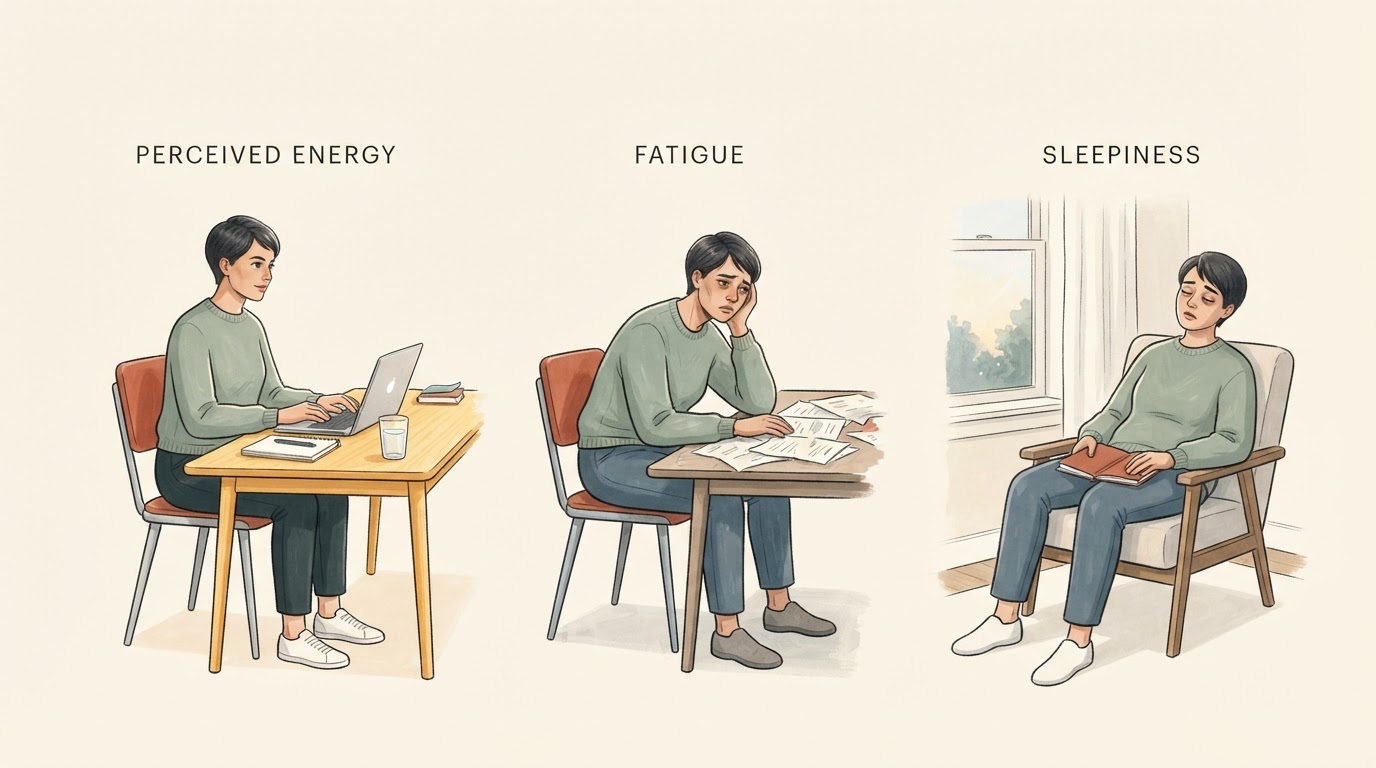
Although they may overlap, these experiences are not identical.
- Perceived energy: Your subjective sense of physical or mental energy.
- Fatigue: Weariness, exhaustion, or reduced energy that may interfere with everyday activities.
- Sleepiness: A feeling that you need to sleep or are having difficulty staying awake.
The MedlinePlus Medical Encyclopedia distinguishes fatigue from drowsiness and explains that fatigue may have many possible causes.
You might feel physically tired without wanting to sleep, or feel sleepy even when you are motivated to finish a task.
What Tracking Can and Cannot Tell You
Energy tracking may reveal repeated experiences or circumstances worth exploring.
It cannot identify whether fatigue comes from sleep problems, medication, stress, an underlying health condition, or another cause.
A pattern is not proof of cause and effect. Even when two events occur together repeatedly, other explanations may exist.
Treat your notes as observations, not diagnoses.
Review Your Patterns After a Few Days
Energy tracking can become more useful when you spend a few minutes reviewing several days of entries.
You do not need complicated calculations or charts. Focus on what seems consistent, what changes, and which observations are difficult to explain.
Questions to Ask After 5–7 Days
Use these questions to guide your review:
- Do I notice higher or lower energy at similar times of day?
- How do my ratings compare after nights when I felt well-rested?
- Do particularly demanding days appear alongside lower energy?
- What do I notice about activity levels and rest breaks?
- Are there exceptions to the patterns I think I see?
- Is anything concerning enough to discuss with a healthcare professional?
Time of day can be relevant, but there is no universal schedule for feeling energetic.
The National Heart, Lung, and Blood Institute explains that circadian rhythms and the body’s pressure for sleep influence wakefulness. Individual sleep schedules and circumstances also matter.
A few days of notes may offer an initial picture of your experiences. They cannot establish your permanent biological rhythm.
What if you find no clear pattern? That is useful information, too. You can continue for a little longer, simplify what you record, or stop if tracking does not seem helpful.

Choose One Small Next Step
If your observations suggest something you would like to explore, consider one realistic adjustment.
For example, if late caffeine consumption often appears alongside restless nights, you might try having it earlier. The CDC recommends avoiding caffeine in the afternoon or evening as part of healthy sleep habits.
If long periods of demanding work coincide with feeling drained, consider whether your schedule allows more opportunities for rest.
Avoid changing several habits at once just to improve a number.
Most importantly, do not push yourself to exercise more when activity causes unusual exhaustion or worsening symptoms.
The goal is to make thoughtful choices while respecting your circumstances and limits.
Common Energy Tracking Mistakes to Avoid
Energy tracking should make your observations clearer, not more complicated.
Watch for four common mistakes:
- Tracking too frequently. Constant check-ins may become distracting. Choose a manageable routine instead.
- Confusing energy with productivity. Completing many tasks does not necessarily mean you felt energetic. Rest is not a failure.
- Assuming correlation means causation. Feeling tired after lunch does not establish that the meal caused your fatigue.
- Comparing your ratings with someone else’s. A 3/5 rating may mean something different to each person.
Use your entries to understand your own experiences, not to judge how well you performed during the day.
When Low Energy Needs Medical Attention
Everyday fluctuations in energy are not automatically signs of illness. However, persistent or unexplained fatigue should not be dismissed.
According to MedlinePlus, fatigue can be associated with sleep disorders, medications, mental health conditions, and various physical illnesses.
The National Health Service (NHS) advises seeking medical evaluation when unexplained tiredness lasts for weeks, affects daily life, or occurs alongside other concerning symptoms.
Do not wait to finish your energy journal before getting medical help.
Sudden serious symptoms, such as severe chest pain or significant difficulty breathing, may require emergency care. In the United States, call 911 when appropriate, as outlined in MedlinePlus guidance on emergency care.
Another important concern is post-exertional malaise, in which symptoms worsen after physical or mental exertion, sometimes with a delay. The CDC identifies this as an important feature of conditions such as ME/CFS. People experiencing this pattern should seek professional guidance rather than trying to overcome it by pushing harder.
Medical Note: This article is intended for general educational purposes and does not provide medical advice, diagnosis, or treatment. A personal energy journal cannot determine the cause of persistent fatigue. Consult a qualified healthcare professional about unexplained or concerning symptoms.
Frequently Asked Questions
How Long Should I Continue Energy Tracking?
Five to seven days can be a manageable starting point, but there is no required duration for an informal energy journal.
You can continue if the entries help you understand your routine, reduce how often you record, or stop when tracking no longer feels useful.
Do not postpone medical evaluation just to collect more observations.
Should I Track Fatigue or Sleepiness Separately?
You can, particularly if those experiences feel different to you.
For example, a short note such as “sleepy but not physically tired” may provide more context than a single energy rating.
You do not need additional scales unless they genuinely make your record more useful. The goal is clarity, not collecting as many measurements as possible.
Keep the Practice Sustainable
Energy tracking is a tool for observation, not a test you need to pass.
Start with a few convenient check-ins, record what feels relevant, and review your notes without expecting perfect patterns or immediate answers.
Copy the checklist, try it for a few days, and see what you notice. Keep the parts that help you understand your routine and let go of anything that makes the process unnecessarily demanding.
Sources
National Library of Medicine — MedlinePlus: Fatigue
https://medlineplus.gov/fatigue.html
National Library of Medicine — MedlinePlus Medical Encyclopedia: Fatigue
https://medlineplus.gov/ency/article/003088.htm
Centers for Disease Control and Prevention — About Sleep
https://www.cdc.gov/sleep/about/index.html
National Heart, Lung, and Blood Institute — What Makes You Sleep?
https://www.nhlbi.nih.gov/health/sleep-deprivation/body-clock
British Heart Foundation — Your Personal Fatigue Diary
https://www.bhf.org.uk/informationsupport/publications/living-with-a-heart-condition/your-personal-fatigue-diary
National Health Service — Tiredness and Fatigue
https://www.nhs.uk/symptoms/tiredness-and-fatigue/
Centers for Disease Control and Prevention — Strategies to Prevent Worsening of Symptoms in ME/CFS
https://www.cdc.gov/me-cfs/hcp/clinical-care/treating-the-most-disruptive-symptoms-first-and-preventing-worsening-of-symptoms.html
National Library of Medicine — MedlinePlus: When to Use the Emergency Room
https://medlineplus.gov/ency/patientinstructions/000593.htm