
Does it matter whether you eat dinner at 6 p.m. or 9 p.m.? Should you eat every three hours? Is breakfast essential? Meal timing can matter in some contexts, but not in the rigid way many popular rules suggest. Researchers increasingly study chrononutrition—how the timing of food intake interacts with circadian rhythms, metabolism, and health—while emphasizing that more research is needed before specific schedules can be broadly prescribed.
The more useful question is not “What is the perfect time to eat?” It is “Which parts of meal timing actually matter for my routine, sleep, digestion, and health?”
Quick Takeaways
- There is no universal best time for breakfast, lunch, or dinner.
- Later eating may affect hunger and glucose responses in some circumstances, but 8 p.m. is not a universal biological cutoff.
- Research has not established one ideal number of meals or a rule that everyone should eat every two or three hours.
- Eating close to bedtime matters more in certain situations, particularly for people with nighttime acid reflux.
- If you have diabetes or take medications that can cause low blood sugar, meal timing may require individualized guidance.
What Does Meal Timing Actually Mean?
Meal timing involves more than the hour displayed on a clock. Researchers may look at when meals happen, how food intake is distributed across the day, how many meals and snacks someone eats, how close eating occurs to sleep, and how long the daily eating window lasts.
Clock Time, Meal Frequency, and Eating Windows Are Not the Same Thing
Eating three meals instead of six is a meal-frequency question. Finishing dinner several hours before bed is a timing-relative-to-sleep question. Time-restricted eating deliberately limits food intake to a defined daily window and is a more specific dietary strategy.
These questions are related, but they are not interchangeable. Evidence about one form of meal timing should not automatically be used to justify another.

Does Meal Timing Really Matter?
There are biological reasons to study when we eat. Circadian rhythms help coordinate sleep, hormone signaling, metabolism, and other processes across the day, while food intake may act as an additional timing signal for some metabolic systems.
Why Researchers Study Earlier and Later Eating
In a controlled study involving 10 healthy young men, researchers delayed meals by five hours and found shifts in blood glucose rhythms and a molecular clock marker in fat tissue. Some markers of the body’s central clock did not shift.
That study helps explain why meal timing is biologically interesting. It does not show that everyone should eat dinner at a particular hour or that an occasional late meal causes disease.
What the Evidence Can—and Cannot—Tell Us
A 2026 systematic review and meta-analysis of 44 human intervention studies found that earlier meal timing showed potentially favorable effects on some glucose measures compared with later eating. However, most included studies lasted no more than one week, and differences among study designs were substantial. The authors concluded that the evidence was not sufficient for firm clinical meal timing recommendations.
Another controlled crossover study in adults with overweight or obesity found that later eating increased hunger and reduced waking energy expenditure under carefully controlled laboratory conditions. Those results help researchers understand possible mechanisms, but they do not prove that one late dinner causes weight gain or that everyone responds the same way.
The practical takeaway is simple: meal timing deserves attention, but the evidence does not support a universal timetable.
Common Meal-Timing Questions and Mistakes
Many meal-timing rules sound precise. The evidence is usually more nuanced.
Is Eating After 8 PM Bad for You?
There is no established metabolic switch that suddenly makes food “bad” at 8 p.m.
Researchers studying late eating often consider the relationship between food intake and a person’s habitual sleep or circadian timing rather than treating a particular clock hour as universal.
For example, a randomized crossover study involving 845 participants compared an early condition four hours before habitual bedtime with a late condition one hour before bedtime. Glucose tolerance was worse in the later condition, with differences also related to a genetic variant involving melatonin signaling.
That does not mean everyone should finish dinner by a certain hour. Someone who sleeps at 9:30 p.m. and someone who sleeps at 1 a.m. can both eat at 8 p.m., yet that meal falls at very different points in their sleep-wake schedules.

A better question is: How late am I eating relative to my usual bedtime and routine?
Do You Have to Eat Breakfast?
Breakfast should not be prescribed as a universal weight-loss strategy, and skipping it should not be treated as a guaranteed health advantage either.
A systematic review and meta-analysis of randomized trials found that adding breakfast did not show a weight-loss advantage. The authors also cautioned that the included studies were generally short and had important quality limitations.
For many people, whether breakfast fits well depends on hunger, schedule, activity, food choices, and medical needs—not on the idea that eating in the morning automatically “boosts” metabolism.
READ MORE:
Meal Timing and Digestion: How to Build a Routine That Feels Sustainable
Should You Eat Every Two or Three Hours?
There is no well-established rule requiring healthy adults to eat every two or three hours.
A USDA systematic review found that researchers could not draw a firm conclusion about the relationship between the number of daily eating occasions and energy intake in adults because the available evidence was small and had limited generalizability. The same review found insufficient evidence to reach firm conclusions about adult snacking and energy intake.
A separate USDA review found moderate evidence that the number of eating occasions per day was not associated with changes in weight or body composition among adults in the studies evaluated.
Eating every few hours may suit some people. Others prefer fewer meals. The evidence does not establish one frequency as universally superior.
Are Six Small Meals Better Than Three?
Not necessarily.
Meal frequency may influence convenience, hunger management, and how food fits into daily life, but current evidence does not establish six small meals as metabolically superior to three meals for everyone.
The number of meals should make sense for the person’s needs, appetite, routine, and overall dietary pattern rather than follow a fixed rule.
Is Time-Restricted Eating Necessary for Good Meal Timing?
No.
Time-restricted eating limits food intake to a defined daily window. A 2026 systematic review and network meta-analysis of randomized controlled trials found improvements in several metabolic outcomes with time-restricted eating compared with usual diets, while also showing that protocols differed in timing and eating-window duration.
That makes time-restricted eating an active area of research—not a requirement for healthy meal timing. You can have a flexible, structured eating routine without using a restricted eating window.
| Common rule | A more accurate interpretation |
|---|---|
| “Never eat after 8 p.m.” | There is no universal cutoff; bedtime and individual context matter. |
| “Eat every three hours.” | Research has not established one ideal meal frequency. |
| “Breakfast boosts your metabolism.” | Breakfast can fit a healthy diet, but it is not a guaranteed weight-loss strategy. |
| “Six small meals are always better.” | The number of meals should fit individual needs and routine. |
| “Everyone needs an eating window.” | Time-restricted eating is an optional strategy, not a requirement. |
Meal Timing, Digestion, and Eating Before Bed
For digestive comfort, the relationship between a meal and bedtime can sometimes be more useful than the exact hour on the clock. Timing may be easier to interpret when you consider meal size, bedtime, and symptoms together.
When Bedtime Matters More Than the Clock
If you repeatedly notice discomfort after large or late meals, consider the relationship among meal timing, meal size, bedtime, and symptoms instead of assuming that one specific hour is the problem.
This is where a personalized routine becomes more useful than a rigid clock rule.
For a practical approach to building that routine, read Meal Timing and Digestion: How to Build a Routine That Feels Sustainable.
Reflux Is a Specific Case
People who experience nighttime gastroesophageal reflux disease, or GERD, have more specific guidance.
The National Institute of Diabetes and Digestive and Kidney Diseases states that people with GERD symptoms at night or while lying down may improve symptoms by eating meals at least three hours before lying down or going to bed.
That advice applies to a specific symptom pattern. It should not be turned into a universal three-hour food cutoff for metabolism or general wellness.
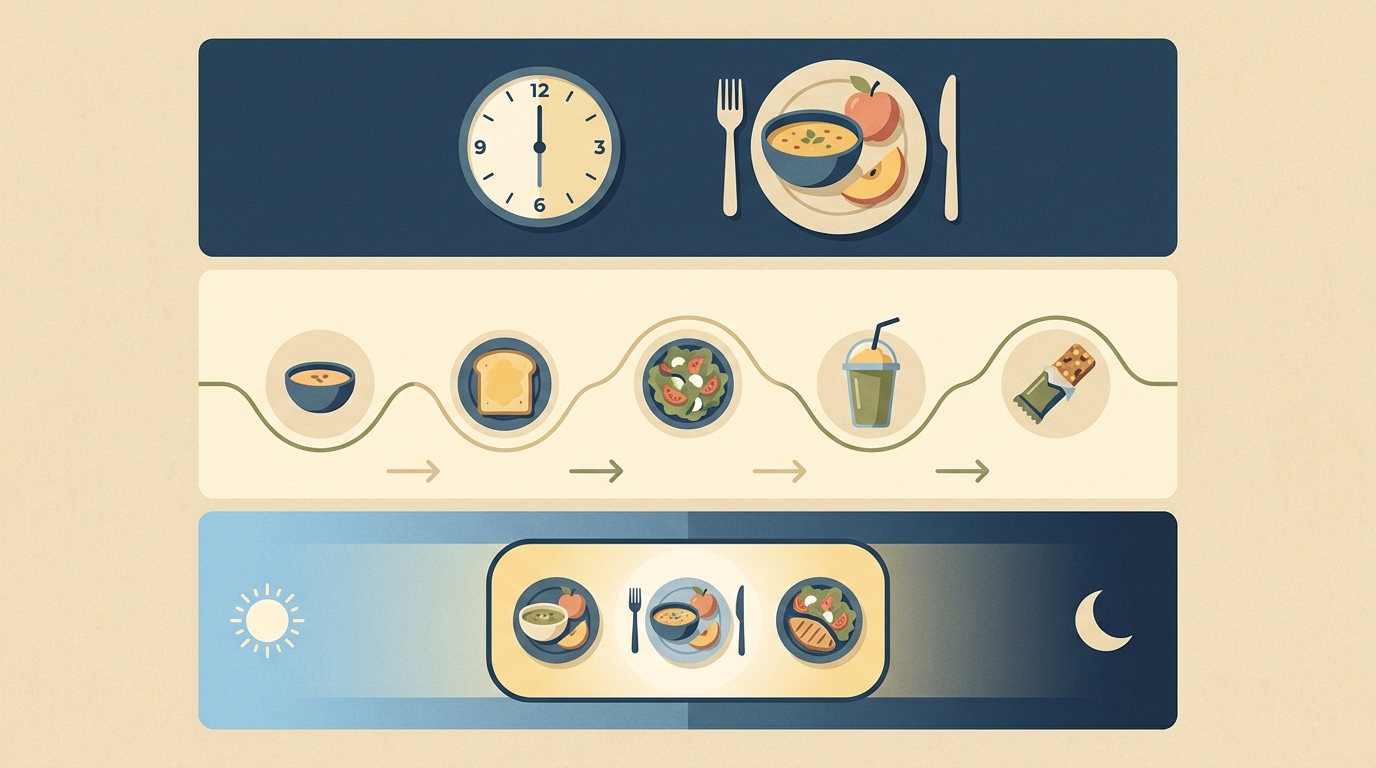
Meal Timing, Blood Sugar, and Metabolic Health
Blood glucose is one of the better-studied areas within chrononutrition, and timing may influence glucose responses under some conditions.
Earlier Eating May Affect Glucose Responses
The 2026 review of intervention studies found that earlier meal timing may produce more favorable post-meal glucose responses than later eating, particularly in short-duration studies. But the authors emphasized the high variability among studies and the need for larger, longer trials before clinical dietary guidelines can be established.
It is therefore reasonable to say that meal timing may influence glucose responses. It is not reasonable to claim that eating dinner at one particular hour prevents diabetes.
Timing is only one part of the picture. Overall food choices, activity, sleep, medications, and individual health needs remain important.
Diabetes Changes the Conversation
For someone with diabetes, meal timing can be more than a lifestyle preference.
The American Diabetes Association’s 2026 Standards of Care recommend individualized nutrition planning. For people using fixed insulin doses, consistent carbohydrate patterns with respect to both timing and amount can help improve glycemia and reduce the risk of hypoglycemia.
The NIDDK also notes that the best times for meals and snacks may depend on diabetes medications, physical activity, work schedules, and other health conditions. That is one reason major changes to meal timing should not be treated as a generic wellness experiment when medications or diabetes management are involved.
How to Think About Meal Timing in Your Own Routine
For most healthy adults, it is more useful to treat meal timing as a framework rather than a stopwatch.
Use Routine Without Becoming Rigid
Start with the realities of your day: sleep, work hours, physical activity, hunger, family meals, cultural habits, and digestive comfort.

A simple reality check can help:
- Does my schedule fit my usual work and sleep routine?
- Am I frequently eating very large meals immediately before bed?
- Am I following a certain time because it works for me—or because I heard it was a universal rule?
- Do certain patterns repeatedly coincide with reflux or digestive discomfort?
- Do medications or a medical condition make meal timing more important?
- Am I focusing so heavily on timing that I am overlooking overall food quality?
The current Dietary Guidelines for Americans emphasize overall dietary patterns and nutrient-dense foods rather than prescribing precise meal hours as the foundation of healthy eating.
For a broader look at everyday digestive habits, see Gut Health Basics: Everyday Habits for Better Digestion.
When Meal Timing Questions Need Professional Guidance
Experimenting with a flexible schedule is different from trying to manage persistent symptoms or a medical condition on your own.
Talk with a health care professional or registered dietitian if you have frequent reflux, ongoing digestive symptoms, diabetes, or medications that make meal timing clinically important.
According to the NIDDK, you should see a doctor right away if indigestion occurs with symptoms such as chest pain; difficulty or pain with swallowing; frequent vomiting; bloody vomit; severe, constant abdominal pain; unexplained weight loss; loss of appetite; or black, tarry stools. Persistent indigestion that does not improve also warrants medical evaluation.
The Bottom Line on Meal Timing
Meal timing is not meaningless, but finding a supposedly perfect hour is usually less useful than understanding the broader pattern.
Research suggests that earlier versus later eating can influence glucose responses, hunger, and other metabolic processes under certain conditions. At the same time, current evidence does not justify assigning everyone the same breakfast, lunch, and dinner schedule.
For most people, a practical routine should work with sleep, hunger, daily responsibilities, digestive comfort, and overall diet quality. When reflux, diabetes, medications, or persistent symptoms are involved, individualized guidance matters more than a rule on the clock.
Want a practical way to put these ideas into your daily routine? Read Meal Timing and Digestion: How to Build a Routine That Feels Sustainable.
Medical Note
This article provides general wellness information and is not a substitute for individualized medical care. If you have diabetes, take insulin or medications that can cause hypoglycemia, or have persistent digestive symptoms, discuss meaningful changes to meal timing with your health care professional.
Sources
- National Heart, Lung, and Blood Institute (NHLBI). Chrononutrition: Timing of Meals Matters for Your Health.
https://www.nhlbi.nih.gov/news/2023/chrononutrition-timing-meals-matters-your-health - Wehrens SM, et al. Meal Timing Regulates the Human Circadian System. Current Biology.
https://pubmed.ncbi.nlm.nih.gov/28578930/ - Slebe R, et al. Effects of Timing of Meal Intake on Glucose Metabolism: A Systematic Review and Meta-Analysis of Human Intervention Studies. Nutrition, Metabolism and Cardiovascular Diseases. 2026.
https://pubmed.ncbi.nlm.nih.gov/42580983/ - Vujović N, et al. Late Isocaloric Eating Increases Hunger, Decreases Energy Expenditure, and Modifies Metabolic Pathways in Adults With Overweight and Obesity. Cell Metabolism.
https://pubmed.ncbi.nlm.nih.gov/36198293/ - Garaulet M, et al. Interplay of Dinner Timing and MTNR1B Type 2 Diabetes Risk Variant on Glucose Tolerance and Insulin Secretion. Diabetes Care.
https://pubmed.ncbi.nlm.nih.gov/35015083/ - Sievert K, et al. Effect of Breakfast on Weight and Energy Intake: Systematic Review and Meta-Analysis of Randomised Controlled Trials. BMJ.
https://pubmed.ncbi.nlm.nih.gov/30700403/ - USDA Nutrition Evidence Systematic Review. Frequency of Meals and/or Snacking and Energy Intake.
https://nesr.usda.gov/2025-dietary-guidelines-advisory-committee-systematic-reviews/frequency-meals-snacks_energy-intake - USDA Nutrition Evidence Systematic Review. Frequency of Meals and/or Snacking and Growth, Body Composition, and Risk of Obesity.
https://nesr.usda.gov/2025-dietary-guidelines-advisory-committee-systematic-reviews/frequency-meals-snacks_growth-obesity - National Institute of Diabetes and Digestive and Kidney Diseases. Eating, Diet, & Nutrition for GER & GERD.
https://www.niddk.nih.gov/health-information/digestive-diseases/acid-reflux-ger-gerd-adults/eating-diet-nutrition - American Diabetes Association. Standards of Care in Diabetes—2026: Facilitating Positive Health Behaviors and Well-being to Improve Health Outcomes.
https://diabetesjournals.org/care/article/49/Supplement_1/S89/163932 - National Institute of Diabetes and Digestive and Kidney Diseases. Healthy Living with Diabetes.
https://www.niddk.nih.gov/health-information/diabetes/overview/healthy-living-with-diabetes - National Institute of Diabetes and Digestive and Kidney Diseases. Symptoms & Causes of Indigestion.
https://www.niddk.nih.gov/health-information/digestive-diseases/indigestion-dyspepsia/symptoms-causes/ - U.S. Department of Health and Human Services, Office of Disease Prevention and Health Promotion. Dietary Guidelines for Americans, 2025–2030.
https://odphp.health.gov/our-work/nutrition-physical-activity/dietary-guidelines/current-dietary-guidelines - Systematic Review and Network Meta-Analysis. Effects of Timing and Eating Duration of Time-Restricted Eating on Metabolic Outcomes.
https://pubmed.ncbi.nlm.nih.gov/41586347/