
Walking gear can make everyday walks more comfortable, easier to track, or more practical in certain conditions. But you don’t need an expensive collection of equipment to build a consistent walking routine. The challenge is knowing which accessories deserve your attention before spending money.
Walking shoes, step counters, and visibility gear serve different purposes. Their usefulness depends on your current footwear, personal preferences, walking environment, and individual needs.
This guide explains how to evaluate walking gear before buying, using three real products as examples. You’ll learn what their features offer, where they fall short, and when a simpler alternative may be enough.
Which Walking Gear Do You Actually Need?
Before shopping, consider what you want an accessory to accomplish.
If your current shoes fit comfortably and work well on your usual walking surfaces, replacing them may not be necessary. If you enjoy walking without tracking numbers, you may not need a pedometer. And if you only walk during daylight hours, an illuminated vest could add little value.
The Centers for Disease Control and Prevention (CDC) identifies brisk walking as one way older adults can meet aerobic activity recommendations. Those recommendations focus on physical activity, not purchasing specialized equipment.
Here’s a simple way to evaluate your needs.
| Your situation | Gear to consider | What matters most | When you may not need it |
|---|---|---|---|
| Your shoes are worn, uncomfortable, or poorly suited to your route | Walking shoes | Fit, heel security, and traction | Your current shoes already work well |
| You want an easy way to monitor daily steps | Simple pedometer | Readable display and easy operation | You prefer tracking walking time or using an existing device |
| You regularly walk in low-light conditions | Reflective or illuminated gear | Visibility, fit, and ease of use | You walk only in well-lit daytime conditions |
These categories address different needs. They aren’t interchangeable, and you don’t need to purchase all three.
For most people, choosing practical walking gear starts with one question: Will this product solve a problem I actually have?
If you’re still developing your routine, understanding the basics of daily walking may be more helpful than choosing equipment immediately.
Walking Shoes: Fit and Traction Before Extras
Among walking gear purchases, shoes deserve particular attention when your current pair causes discomfort or shows noticeable wear.
However, a shoe advertised as lightweight or highly cushioned isn’t necessarily suitable for everyone.
What to Look For in Everyday Walking Shoes
The American Academy of Orthopaedic Surgeons (AAOS) emphasizes proper fit when selecting athletic footwear.
Four features deserve particular attention:
- Room in the toe box: Your toes should move comfortably without feeling crowded. AAOS recommends approximately half an inch between your longest toe and the front of the shoe.
- Secure heel fit: The heel counter should help keep your heel in place without uncomfortable pressure or excessive slipping.
- Appropriate traction: Consider the surfaces where you normally walk, especially if your routes include wet pavement or uneven ground.
- Comfort and support: Try walking in the shoes rather than judging them only by how soft they feel while standing.
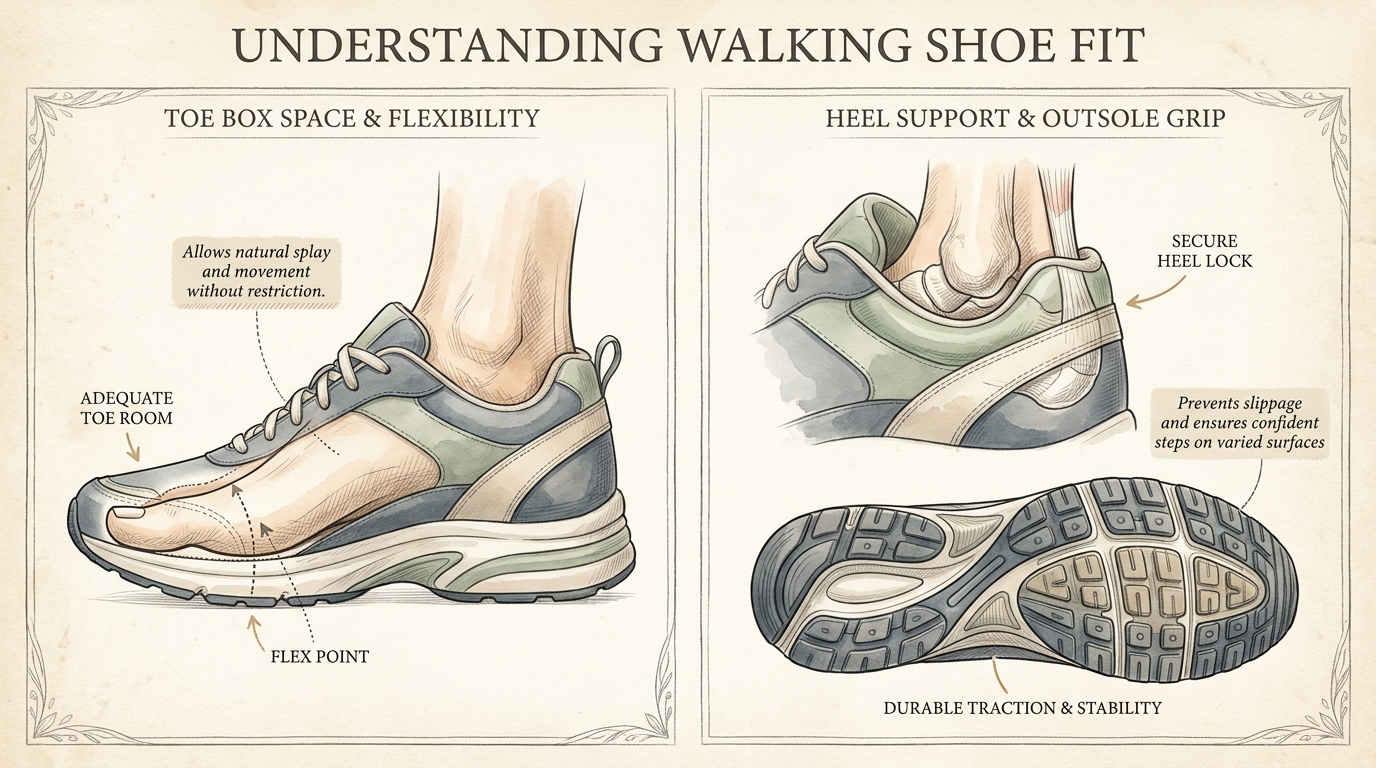
Shoe size alone doesn’t guarantee a good fit. Width, foot shape, and the design of the upper also matter.
If possible, try shoes on while wearing your usual walking socks. Check both feet and avoid assuming that discomfort will disappear after breaking them in.
Product Example: Skechers GO WALK Joy – Ecstatic
The Skechers GO WALK Joy – Ecstatic is a women’s walking sneaker designed around lightweight construction and easy everyday wear.
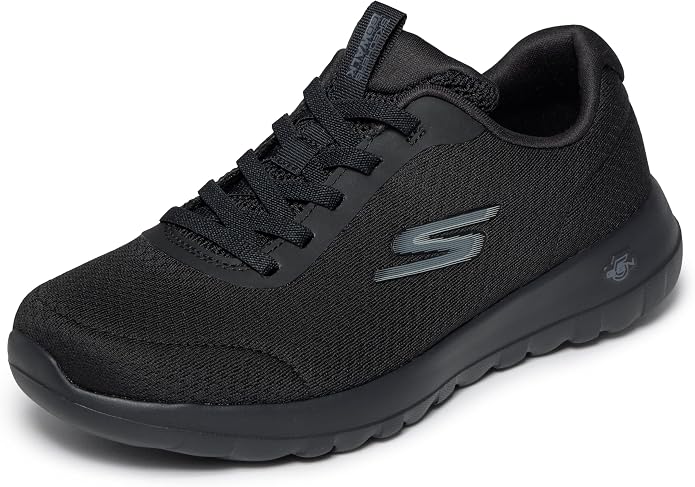
According to Skechers’ product specifications, the model features a mesh upper, stretch laces, an Air-Cooled Goga Mat insole, a cushioned 5GEN midsole, and a flexible outsole.
Its main appeal is convenience. The slip-on construction eliminates the need to tie traditional laces, while the lightweight materials and cushioning may appeal to walkers who prefer a softer feel.
Who might consider it? Someone looking for a lightweight, easy-to-put-on walking shoe who feels comfortable with its fit and support characteristics.
>>> Check the Skechers GO WALK Joy on Amazon <<<

Step Counters: Track Progress Without a Smartwatch
Some walkers enjoy seeing how many steps they take during the day. Others find that numbers add pressure to an activity they would rather keep simple.
Not every piece of walking gear needs to measure progress. A step counter can be useful, but it isn’t a requirement for maintaining a walking routine.
What a Simple Pedometer Can [and Cannot] Do
A pedometer uses movement sensors to estimate steps. Unlike a smartwatch, a basic model may display that information without requiring a smartphone, account, or mobile application.
There is evidence that activity monitoring can support behavior change.
A 2022 systematic review published in The BMJ examined 121 randomized controlled trials and found that interventions using physical activity monitors and feedback were associated with increased physical activity.
However, the findings apply to monitoring interventions as a whole, not to any specific consumer pedometer. Individual results vary, and the study’s eligibility criteria limit how confidently its findings can be generalized to adults over 65.
Accuracy also deserves attention.
A small 2012 study involving 18 participants found that several pedometers became less accurate at slower walking speeds. The study tested five older devices, not the 3DFitBud.
This highlights why step counts should be viewed as estimates rather than clinical measurements, particularly when walking patterns differ from typical conditions.
READ MORE:
Product Example: 3DFitBud Simple Step Counter
The 3DFitBud Simple Step Counter, made by 3DActive, is designed for people who want uncomplicated step tracking.
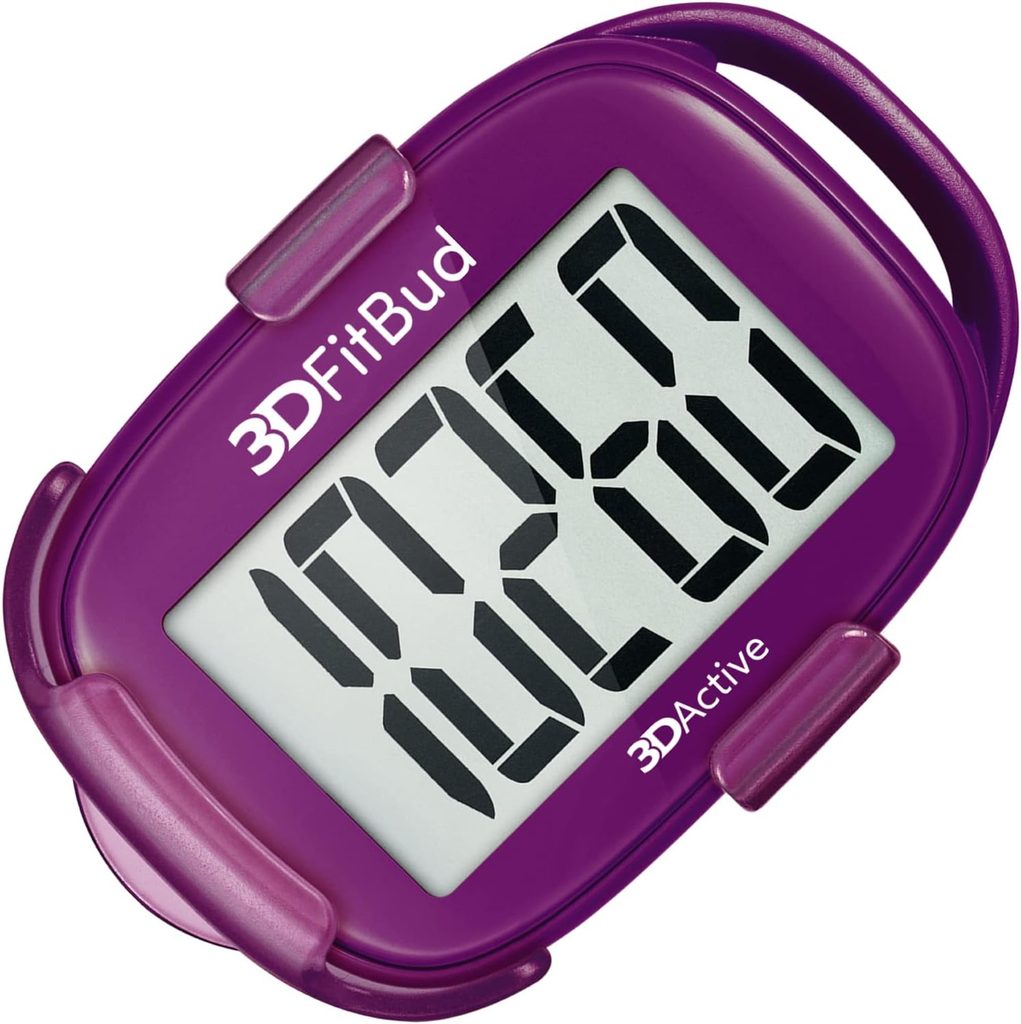
Its defining feature is simplicity.
According to 3DActive, the device uses a three-axis motion sensor and displays steps on a large LCD screen. It includes a removable clip and lanyard, allowing different wearing positions.
There’s no app to download or Bluetooth connection to manage.
The counter operates on a replaceable CR2032 coin-cell battery. The manufacturer advertises battery life of up to 12 months, depending on use.
A manual reset button lets users clear the displayed step total when they want to begin another count.
For more consistent readings, the manufacturer recommends wearing the pedometer at the waistline and keeping it in the same position from day to day.

Potential advantages include readable numbers, minimal setup, and no need for a smartwatch or subscription.
The manufacturer also warns that the coin-cell battery must be kept out of children’s reach.
Who might consider it? Someone who wants a straightforward step count without learning a new app.
A notebook or simple walking log can be a reasonable alternative when recording steps isn’t important.
>>> Check the 3DFitBud on Amazon <<<
Visibility Gear for Early-Morning or Evening Walks
Visibility-focused walking gear may deserve extra consideration if you regularly walk before sunrise, after sunset, or around poorly lit streets.
However, the right approach depends on your route, traffic exposure, lighting, and walking schedule.
Reflective Gear vs. Lights: What Matters?
Reflective materials and illuminated accessories work differently.
Reflective materials return light from an outside source, such as vehicle headlights. Illuminated products generate their own light, making the wearer more noticeable without depending entirely on reflected light.
Neither automatically illuminates the ground ahead.
A separate flashlight may still be useful for identifying obstacles, steps, or uneven surfaces.
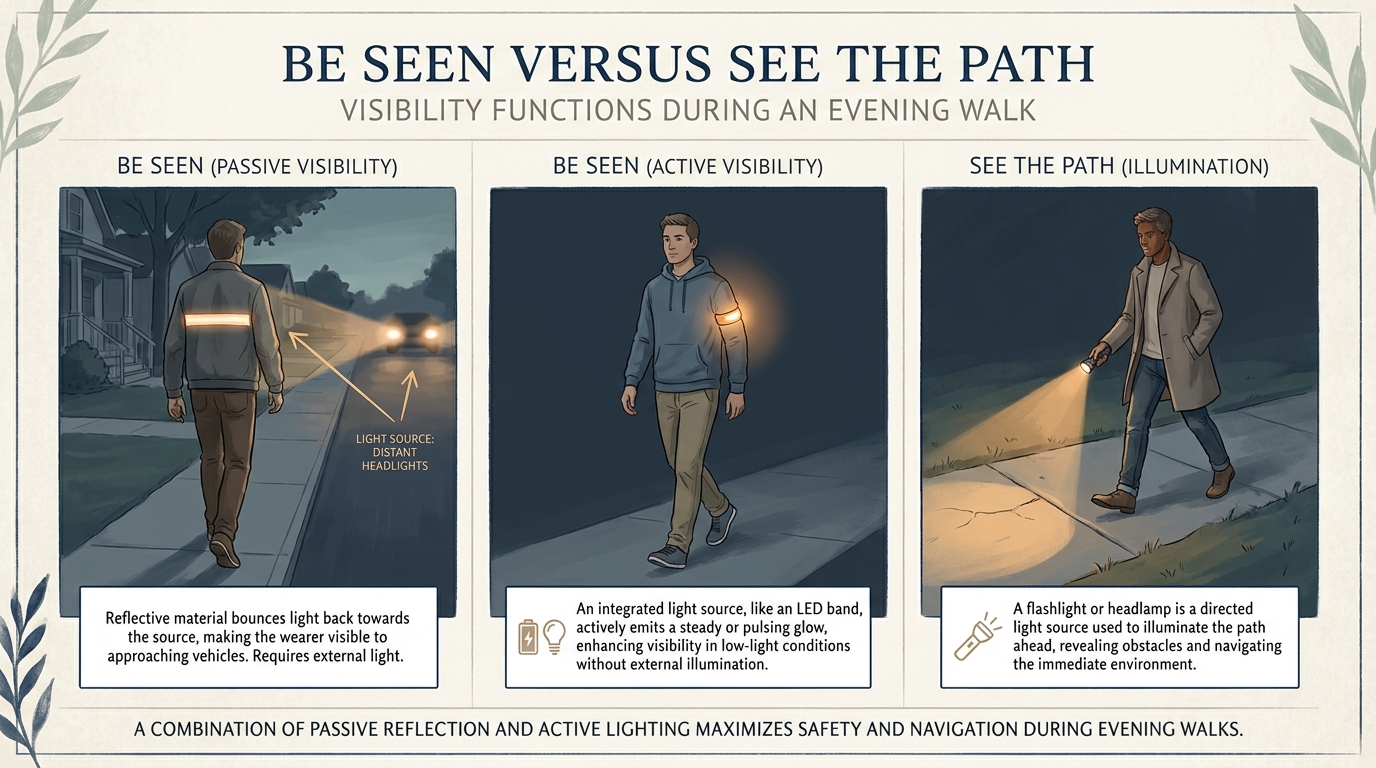
The National Institute on Aging recommends walking during daylight when possible. For nighttime outdoor activity, it advises using reflective materials and carrying a flashlight.
Choosing well-lit routes, paying attention to traffic, and adjusting plans to weather conditions remain important regardless of the accessories worn.
Product Example: Noxgear Tracer2
The Noxgear Tracer2 is an illuminated visibility vest designed for outdoor activities.
According to its official product specifications, it combines LED illumination, fiber-optic shoulder bands, and an adjustable reflective chest band.
The rechargeable design uses USB-C charging and offers multiple lighting modes and colors.
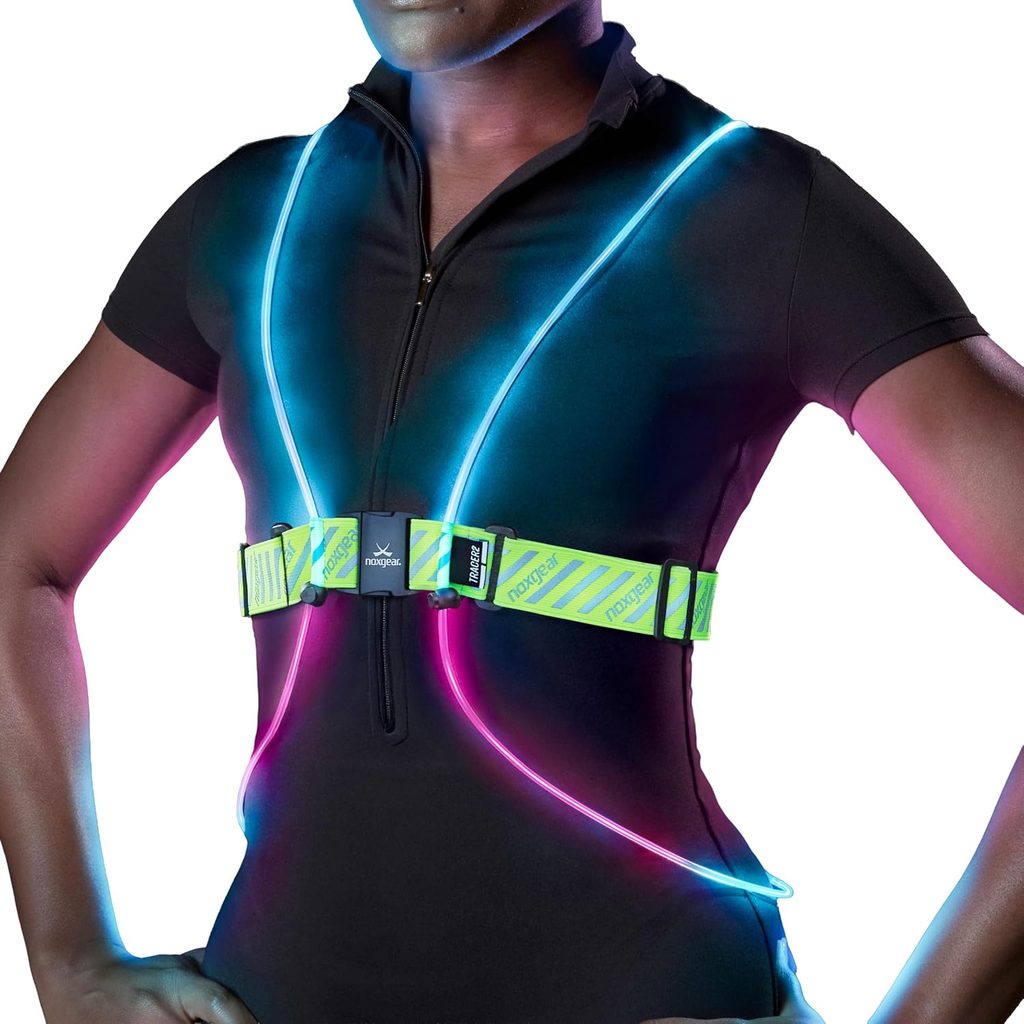
Noxgear advertises a runtime of up to 20 hours under regular-use conditions and an IP67 water-resistance rating. Actual battery life may vary depending on the lighting mode and conditions of use.
These are manufacturer specifications, not independent evidence that the vest prevents accidents.
The main potential advantage is combining active illumination with reflective material in a wearable accessory.
It may be convenient for people who frequently walk in low-light conditions and prefer not to manage several separate visibility accessories.
Who might consider it? Someone who regularly walks early in the morning or in the evening, particularly along routes where additional visibility is desirable.
>>> Check the Noxgear Tracer2 on Amazon <<<
A Practical Checklist Before You Buy Walking Gear
The most useful walking accessory isn’t necessarily the one with the most features. It’s the one that fits your actual needs and is practical to use.
Before purchasing walking gear, work through this checklist.
- Identify the problem. What do you want the accessory to improve? If you can’t identify a specific need, reconsider the purchase.
- Check fit and compatibility. Make sure shoes fit your feet, pedometers work for your walking pattern, and visibility accessories adjust comfortably over your clothing.
- Consider ease of use. Think about buttons, screen readability, charging, battery replacement, and whether an app is required.
- Understand the limitations. Manufacturer descriptions may highlight advantages while giving less attention to situations in which a product performs poorly.
- Consider ongoing costs. Even relatively simple equipment may involve replacement batteries, charging accessories, maintenance, or eventual replacement.
- Review the exact listing and return conditions. Check the model, color, size, seller, current availability, and applicable return policy before purchasing.
For online footwear purchases, pay particular attention to sizing options and whether returns are available if the shoes don’t fit.
For electronic accessories, read the operating instructions and confirm that the features you want are included in the exact version being offered.
A product can be well made and still be the wrong purchase for your circumstances.
If you’re unsure, consider whether you can meet the same need with something you already own.
The Bottom Line: Useful Gear Isn’t Always Necessary
Good walking gear should support your routine, not make it more complicated.
Properly fitting shoes deserve attention. A simple pedometer may be convenient if you enjoy monitoring steps. Reflective or illuminated accessories may be worthwhile when you regularly walk in low-light conditions.
Start with the one need that matters most to your routine, and evaluate whether something you already own can meet it.
If you’re still developing your walking habits, focus on creating a sustainable routine before adding unnecessary equipment.
Your next step: Use the buying checklist above to decide which walking gear, if any, would genuinely help your routine.
Affiliate Disclosure: This article contains product recommendations and may include affiliate links. We may earn a commission from qualifying purchases at no additional cost to you. As an Amazon Associate I earn from qualifying purchases.
Medical Note
This article is for general educational purposes and does not replace individualized medical advice.
If you experience persistent foot pain, balance difficulties, neuropathy, foot wounds, or other conditions affecting walking, consult an appropriate healthcare professional before choosing footwear or changing your activity routine.
The American Diabetes Association specifically emphasizes appropriate footwear and professional care for people with diabetes-related nerve damage or foot problems.
Sources
- Centers for Disease Control and Prevention (CDC). Older Adult Activity: An Overview.
https://www.cdc.gov/physical-activity-basics/guidelines/older-adults.html - National Institute on Aging (NIA). Exercising Outdoors: Safety Tips for Older Adults.
https://www.nia.nih.gov/health/exercise-and-physical-activity/safety-tips-exercising-outdoors-older-adults - American Academy of Orthopaedic Surgeons (AAOS). Athletic Shoes. OrthoInfo.
https://www.orthoinfo.org/staying-healthy/athletic-shoes - Skechers. GO WALK Joy – Ecstatic, Style 124094: Official Product Specifications.
https://www.skechers.in/go-walk-joy—ecstatic/124094.html - RunRepeat. Skechers GOwalk Joy – Ecstatic: Independent Laboratory Review (2023).
https://runrepeat.com/skechers-go-walk-joy-ecstatic - 3DActive. 3DFitBud Simple Step Counter: Product Specifications and Frequently Asked Questions.
https://3dactive.com/products/pedometer-3dfitbud - The BMJ (2022). Effectiveness of Physical Activity Monitors in Adults: Systematic Review and Meta-analysis.
https://www.bmj.com/content/376/bmj-2021-068047 - Pedometer Accuracy in Slow Walking Older Adults (2012). PubMed.
https://pubmed.ncbi.nlm.nih.gov/24795762/ - Noxgear. Tracer2: Official Product Features and Technical Specifications.
https://www.noxgear.com/tracer2 - American Diabetes Association. Foot Complications.
https://diabetes.org/about-diabetes/complications/foot-complications