Fermented foods, probiotics and prebiotics are often discussed together, but each term describes something different.
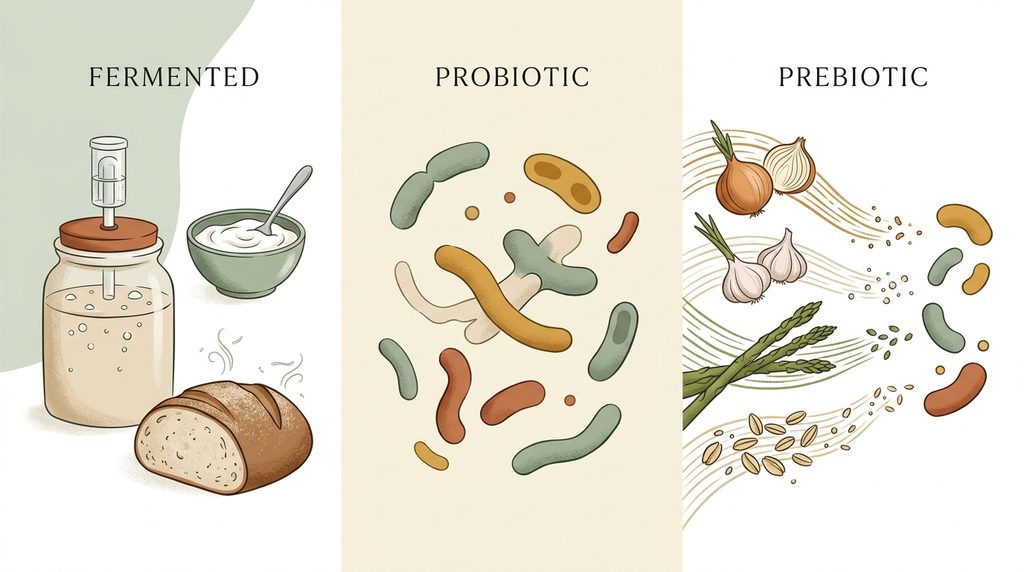
Fermentation is a process used to make food. Probiotics are specific live microorganisms associated with a health benefit when provided in an adequate amount. Prebiotics are substances selectively used by microorganisms in or on the body in a way that provides a health benefit.
Understanding these distinctions can make food labels and broad gut-health claims easier to evaluate. Most importantly, a food does not automatically qualify as probiotic simply because it is fermented or contains live cultures.
Quick Takeaways
- “Fermented” tells you how a food was made, not whether it provides a demonstrated probiotic benefit.
- Some fermented foods contain live microorganisms when eaten, while others do not.
- Probiotic effects depend on the specific microorganism, amount and intended use.
- Prebiotics are not bacteria, and not every type of dietary fiber qualifies as prebiotic.
- The complete food label is usually more informative than one term on the front of a package.
What Are Fermented Foods?
Fermentation Is a Food-Making Process
Fermented foods are made through desired microbial growth and enzymatic changes in food components. During this process, bacteria, yeasts or other microorganisms can change qualities such as flavor, aroma, texture and acidity.
Fermentation describes how a food was produced. It does not guarantee that living microorganisms remain in the finished food, and it does not prove that eating the food will produce a particular health result.
Common Examples of Fermented Foods
Examples include:
- yogurt;
- kefir;
- kimchi;
- sauerkraut;
- miso;
- tempeh;
- sourdough;
- kombucha.
Individual products can differ in ingredients, cultures and processing. Some fermented foods are cooked, pasteurized or otherwise treated after fermentation, so living microorganisms may not remain by the time they are eaten.
Why Fermented Does Not Automatically Mean Probiotic
A fermented food may still contain living cultures, but their presence alone does not establish probiotic status.
The scientific definition of a probiotic involves specific live microorganisms, an adequate amount and an associated health benefit. A food that simply contains unidentified living microorganisms does not automatically meet those criteria.
Keep in mind: A fermented food may contain live microorganisms without qualifying as an established probiotic food.
What Are Probiotics?
Probiotics Are Specific Live Microorganisms
Probiotics are live microorganisms that confer a health benefit when provided in adequate amounts. The term is more specific than “contains bacteria” or “contains live cultures.”
Probiotic research and product identification commonly distinguish microorganisms by genus, species and strain. Those details matter because findings about one strain should not automatically be applied to another. The product, amount and intended use also affect what conclusions are reasonable.
This is why a broad statement such as “probiotics support digestion” does not provide enough information to predict what a particular food or supplement will do.
Live Cultures Are Not Always the Same as Probiotics
A “live cultures” statement generally indicates that viable microorganisms are intended to be present, although its exact meaning and labeling requirements can depend on the type of product.
It does not, by itself, establish that those organisms provide a demonstrated probiotic benefit.
A simple distinction is:
- Live cultures: Viable microorganisms may be present.
- Probiotic: Specific live microorganisms meet additional criteria related to amount and benefit.
Foods and Supplements Are Different Categories
Probiotics can be present in certain fermented foods, added to other foods or sold as dietary supplements.
However, products labeled as probiotic do not all have proven health benefits. Supplements can also differ in their microorganisms, quantities, storage requirements and intended uses.
This guide focuses on the differences among the terms rather than evaluating probiotic supplements.
What Are Prebiotics?
Prebiotics Are Used by Certain Microorganisms
A prebiotic is a substrate selectively used by microorganisms in or on the body in a way that provides a health benefit. “Substrate” simply means a substance that microorganisms can use.
Prebiotics are not living bacteria. They are substances used by certain microorganisms.
You may see prebiotics described as “food for good bacteria.” That phrase is easy to remember, but it leaves out two important parts of the definition: the substance must be used selectively, and a health benefit must be demonstrated.
Are Prebiotics the Same as Fiber?
Not exactly.
Some established prebiotics are fibers or related carbohydrates, including inulin, fructooligosaccharides and galactooligosaccharides. However, not every dietary fiber has been shown to meet prebiotic criteria.
Foods such as onions, garlic, leeks and asparagus contain compounds often discussed in connection with prebiotics. Other plant foods, including oats, legumes and whole grains, provide different types of fiber.
The amount and type vary, so a fiber-containing food should not automatically be labeled prebiotic without considering the specific compound and supporting evidence.
Fermented Foods vs. Probiotics vs. Prebiotics
The simplest way to compare the categories is to ask what each term describes.
| Category | What it describes | Examples | Important limitation |
|---|---|---|---|
| Fermented foods | A food-making process involving microorganisms | Yogurt, kimchi, miso, tempeh and sourdough | The finished food may not contain live microorganisms |
| Probiotics | Specific live microorganisms associated with a demonstrated benefit | Identified microorganisms in certain foods or supplements | Effects depend on the organism, amount and intended use |
| Prebiotics | Substances selectively used by certain microorganisms | Certain fibers and related compounds | Not every fiber qualifies as prebiotic |
Individual foods and products can vary according to their cultures, ingredients and processing.
Can One Food Fit More Than One Category?
Yes. The categories can overlap.
A food can be fermented and still contain live microorganisms. It may also contain fibers or related substances discussed in connection with prebiotics.
However, each classification needs to be considered separately. Fermentation does not prove probiotic status, and the presence of fiber does not automatically establish that a food is prebiotic.
READ MORE:
Eating Slowly: A Small Habit That May Support Comfortable Digestion
The Simplest Way to Remember the Difference
Fermented describes how a food is made.
Probiotic describes specific live microorganisms linked to a benefit.
Prebiotic describes a substance certain microorganisms can use.
How to Read Food Labels More Carefully
Look Beyond the Word “Fermented”
A package that says “fermented” tells you something about the production process. It does not necessarily tell you whether living cultures remain or whether a specific health benefit has been demonstrated.
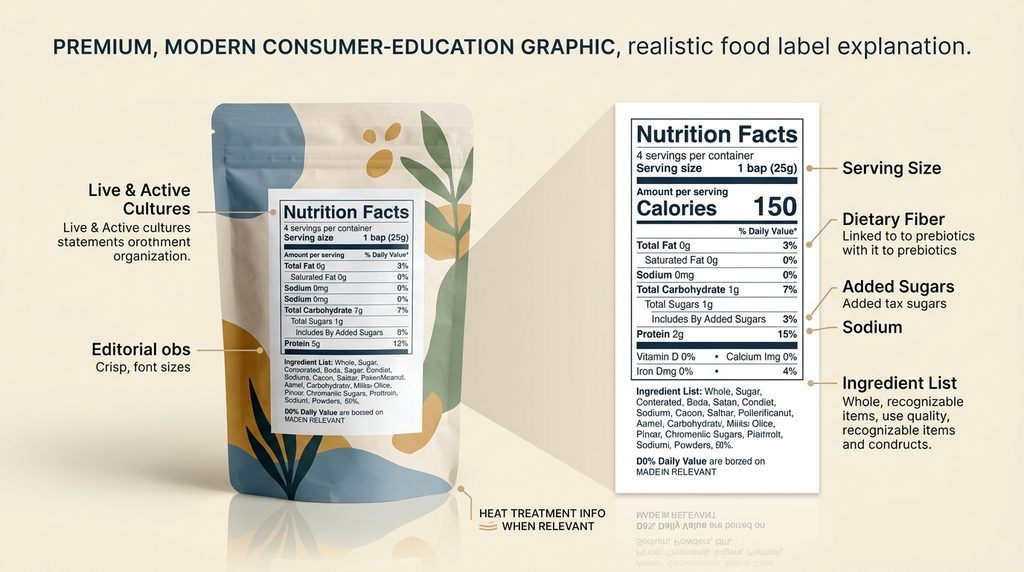
Yogurt offers one clear U.S. labeling example. The FDA has established criteria related to optional “live and active cultures” statements. Yogurt treated to inactivate viable microorganisms must state that it does not contain live and active cultures.
This rule is specific to yogurt and should not be treated as a universal requirement for every fermented food.
Check the Rest of the Nutrition Label
A fermented or culture-containing product is still a complete food. Review the serving size, dietary fiber, added sugars, sodium and ingredient list rather than relying only on a front-of-package term.
The Nutrition Facts label presents nutrient information by serving and can help you compare products.
Broad language about supporting a normal body function should not automatically be interpreted as proof that a food prevents or treats a health condition.
A Practical Label Check
- Does the package make a claim about live cultures?
- Does it say that the food was heat-treated after culturing or fermentation?
- If it makes a probiotic claim, is the microorganism clearly identified, including the strain when available?
- What do the Nutrition Facts show for serving size, fiber, added sugars and sodium?
- What ingredients appear near the top of the ingredient list?
- Is the health language specific, or is it a broad statement?
How These Foods Can Fit Into Everyday Eating
There is no need to search for one “perfect” fermented, probiotic or prebiotic food.
A more realistic approach is to consider variety, preferences, affordability, cultural traditions, dietary restrictions and individual tolerance. These foods and compounds can be part of an eating pattern without needing to carry exaggerated wellness claims.
Practical starting points include:
- choosing familiar foods that fit your normal eating pattern;
- checking labels when the presence of live cultures matters to you;
- introducing more fiber-containing foods gradually;
- noticing how individual foods fit your comfort and preferences.
Adding fiber-containing foods a little at a time may be easier to tolerate than making a large, sudden increase. Too much fiber at once can contribute to gas or discomfort for some people.

When to Talk With a Healthcare Professional
Speak with a qualified healthcare professional about persistent or concerning digestive symptoms, food allergies, dietary restrictions, or questions about using a probiotic supplement with a medical condition.
Professional guidance is especially important before using a probiotic supplement when a person is seriously ill, has a weakened immune system or has other significant medical concerns. Risks can vary by product and population, and serious infections have been reported in vulnerable groups.
When to get help: Seek individualized guidance when digestive symptoms persist, feel concerning or interfere with daily life, or when a medical condition may affect whether a probiotic product is appropriate.
Frequently Asked Questions
Are all fermented foods probiotics?
No. Fermentation describes how a food is produced. A probiotic must involve specific live microorganisms, an adequate amount and an associated health benefit.
Are prebiotics the same as fiber?
No. Some established prebiotics are fibers or related carbohydrates, but not every dietary fiber meets prebiotic criteria.
Can a food be both probiotic and prebiotic?
It can potentially provide both specific live microorganisms and prebiotic substances, but the two classifications need to be evaluated separately. Their coexistence does not prove that every version of the food provides a particular health benefit.
Do I need a probiotic supplement?
There is no formal recommendation for or against probiotic use by all healthy people. Whether a supplement is useful can depend on the product, purpose and individual health context.
Discuss supplements with a qualified healthcare professional when you have a medical condition, use medications or have persistent symptoms.
Putting the Terms in Perspective
Fermented foods, probiotics and prebiotics can overlap, but they do not mean the same thing.
Fermentation is a food-making process. Probiotics are specific live microorganisms associated with a demonstrated benefit. Prebiotics are substances selectively used by microorganisms.
Remembering those distinctions can make food labels and broad gut-health claims easier to evaluate.
For a broader view of everyday habits related to digestive well-being, explore our guide to everyday habits for better digestion.
Medical note: This article provides general educational information and is not a substitute for individualized medical advice. Speak with a qualified healthcare professional about persistent digestive symptoms, medical conditions, dietary restrictions, medications or probiotic supplements.
Sources
- Marco ML, et al. — The International Scientific Association for Probiotics and Prebiotics consensus statement on fermented foods
Used for: the definition of fermented foods, common examples, living microorganisms and the distinction from probiotics.
URL: https://pmc.ncbi.nlm.nih.gov/articles/PMC7925329/ - Hill C, et al. — ISAPP consensus statement on the scope and appropriate use of the term probiotic
Used for: the definition and appropriate application of “probiotic.”
URL: https://www.nature.com/articles/nrgastro.2014.66 - Gibson GR, et al. — ISAPP consensus statement on the definition and scope of prebiotics
Used for: the definition of prebiotics, selective utilization and the distinction from dietary fiber.
URL: https://www.nature.com/articles/nrgastro.2017.75 - NIH Office of Dietary Supplements — Probiotics: Fact Sheet for Health Professionals
Used for: probiotic terminology, strain-specific considerations, food and supplement sources, selection and the absence of a universal recommendation for healthy people.
URL: https://ods.od.nih.gov/factsheets/Probiotics-HealthProfessional/ - National Center for Complementary and Integrative Health — Probiotics: Usefulness and Safety
Used for: evidence limitations, vulnerable populations and supplement-safety considerations.
URL: https://www.nccih.nih.gov/health/probiotics-usefulness-and-safety - U.S. Food and Drug Administration — FDA Amends Standard of Identity for Yogurt
Used for: U.S. yogurt labeling related to live and active cultures and heat treatment.
URL: https://www.fda.gov/food/hfp-constituent-updates/fda-amends-standard-identity-yogurt - U.S. Food and Drug Administration — How to Understand and Use the Nutrition Facts Label
Used for: serving size, dietary fiber, added sugars, sodium and label interpretation.
URL: https://www.fda.gov/food/nutrition-facts-label/how-understand-and-use-nutrition-facts-label - National Institute of Diabetes and Digestive and Kidney Diseases — Eating, Diet, & Nutrition for Irritable Bowel Syndrome
Used for: cautious guidance on introducing additional fiber gradually.
URL: https://www.niddk.nih.gov/health-information/digestive-diseases/irritable-bowel-syndrome/eating-diet-nutrition